Advertisements
Advertisements
प्रश्न
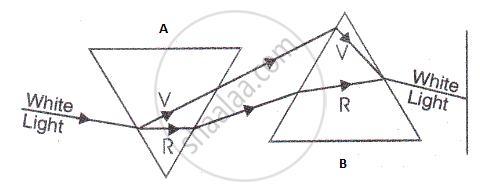
Complete the ray diagram given below to show the nature of light produced on the screen.
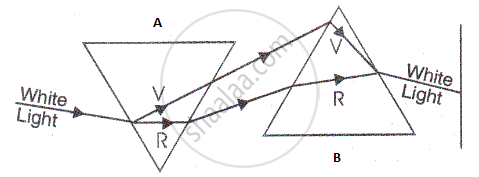
The completed ray diagram is as shown below:
Advertisements
उत्तर
Explanation:
-
A beam of white light enters the first glass prism A.
-
It gets dispersed into its constituent colors, mainly Violet (V) and Red (R) shown here.
-
This is called dispersion of light.
Then, these separated colors pass through a second identical prism B, which is placed in the inverted position compared to A. The second prism recombines the colors back into white light. So, the light coming out of prism B and reaching the screen is white light again.
संबंधित प्रश्न
A student is observing a diagram showing the path of a ray of light passing through a glass prism. He would find that for all angles of incidence the ray of light bends:
What happens when a ray of ordinary light is passed through a triangular glass prism?
Describe how you could demonstrate that white light is composed of a number of colours.
An object is placed in front of a converging lens and in front of a diverging lens as in fig.
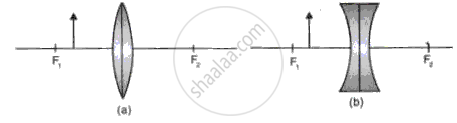
(a)Complete the ray diagram to obtain an image.
(b)Compare the nature of image formed by both the lenses in the above case.
Make the correct choice for each of the following:
Which one of the following Fig correctly shows the path of the ray through the glass block?
A student has to trace the path of a ray of light through a glass prism. List four precautions he should observe for better results.
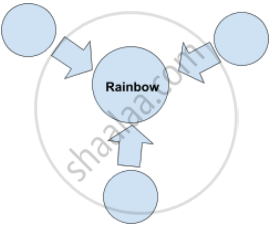
Rainbow is a beautiful natural phenomenon. It is the combined effect of a natural three processes together produced by light. Write it into the circle.
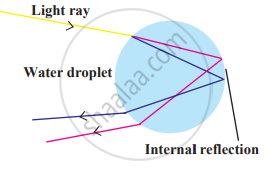
In dispersion, the color of light that will bend more is ______.
During dispersion of white light by prism placed in air, for a particular value of angle of prism,
