Advertisements
Advertisements
प्रश्न
What happens when a ray of ordinary light is passed through a triangular glass prism?
Advertisements
उत्तर
When a ray of ordinary light is passed through a triangular glass prism, the light splits into a spectrum of seven colours. This splitting of light into its constituent colours is called dispersion of light. The role of the prism is to separate the seven colours of the white light.
APPEARS IN
संबंधित प्रश्न
In the formation of spectrum of white light by a prism:
- which colour is deviated least?
- which colour is deviated most?
When a beam of white light is passed through a prism, it splits to form lights of seven colours. Is it possible to recombine the lights of seven colours to obtain the white light again? Explain your answer.
Which of the following coloured light has the least speed in glass prism?
(a) violet
(b) yellow
(c) red
(d) green
When white light passes through a prism, it ............
Explain briefly, with the help of a neat labelled diagram, how white light gets dispersed by a prism. On which surface of a prism, there is both dispersion and deviation of light, and on which surface of the prism, there is only deviation of light ?
- A beam of monochromatic light undergoes minimum deviation through an equiangular prism, how does the beam pass through the prism, with respect to its base?
- If white light is used in the same way as in part (a) above, what change do you expect in the emergent beam?
- What conclusion do you draw about the nature of white light in part (b)?
What conclusion do you draw about the nature of white light in part (b)?
When a white light ray falls on a prism, the ray at its first surface suffers ______.
Differentiate between a glass slab and a glass prism.
How can the presence of ultraviolet radiation be detected?
What do you understand by spectrum? Name the seven prominent colours in order, as obtained in the spectrum of white light.
Observe the given figure and answer the following questions.
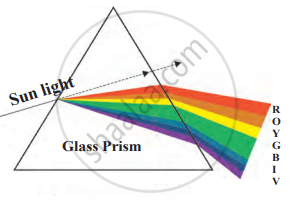
- Which colour light rays bend most?
- Which colour light rays bend least.
- What is the wavelength of violet light rays?
The sunlight can be split into its constituent colors using ______.
The splitting of white light into its component colours is called ____________.
Why do we see a rainbow in the sky only after rainfall?
The periscope is an optical device with a polished surface that reflects the light falling on it.
The dispersive powers of flint glass and crown glass are 0.053 and 0.034, respectively and their mean refractive indices are 1.68 and 1.53 for white light. Calculate the angle of the flint glass prism required to form an achromatic combination with a crown glass prism of refracting angle 4°:
A ray of light is incident at 45° on an equilateral prism in the diagram below.

- Name the phenomenon exhibited by the ray of light when it enters and emerges out of the prism.
- State the cause of the above phenomenon mentioned by you.
Observe the given diagram and answer the questions:
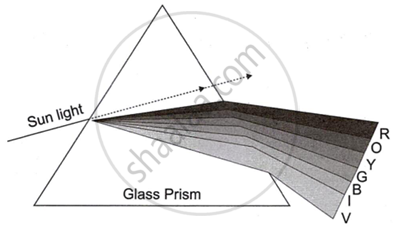
- Name the process shown in the figure.
- Name the colour that deviates the most.
- Name the colour that deviates the least.
- Name any one phenomenon in nature which is based on the above process.
- Define ‘spectrum’.
