Advertisements
Advertisements
प्रश्न
The sunlight can be split into its constituent colors using ______.
Advertisements
उत्तर
The sunlight can be split into its constituent colors using prism.
APPEARS IN
संबंधित प्रश्न
Study the following figure in which a student has marked the angle of incidence (∠i), angle of refraction (∠r), angle of emergence (∠e), angle of prism (∠A) and the angle of deviation (∠D). The correctly marked angles are
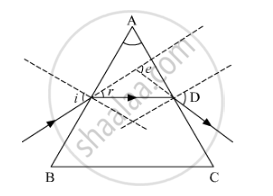
(a) ∠A and ∠i
(b) ∠A, ∠i and ∠r
(c) ∠A, ∠i, ∠e and ∠D
(d) ∠A, ∠i, ∠r and ∠D
Out of air and glass, which is optically rarer? Give reason.
What do you understand by the term spectrum? Name the various colours present in the spectrum of sunlight.
- A beam of monochromatic light undergoes minimum deviation through an equiangular prism, how does the beam pass through the prism, with respect to its base?
- If white light is used in the same way as in part (a) above, what change do you expect in the emergent beam?
- What conclusion do you draw about the nature of white light in part (b)?
What conclusion do you draw about the nature of white light in part (b)?
The frequency range of visible light is from 3.75 × 10¹⁴ Hz to 7.5 × 10¹⁴ Hz. Calculate its wavelength range. Take speed of light = 3 × 10⁸ m/s.
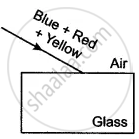
In the figure, a beam of light consisting of three colours blue, red, and yellow is incident on a prism and on a rectangular glass block respectively. Complete the diagram by drawings of the refracted and emergent rays.
Say TRUE or FALSE
Rainbow is formed by dispersion of which light by water drops
Assertion: We can see the rainbow in the sky when the rain starts falling after a spell of bright sunlight.
Reason: The rainbow is formed due to the dispersion of light.
What is a rainbow?
