Advertisements
Advertisements
Question
The sunlight can be split into its constituent colors using ______.
Advertisements
Solution
The sunlight can be split into its constituent colors using prism.
APPEARS IN
RELATED QUESTIONS
In the following diagram, the path of a ray of light passing through a glass prism is shown:
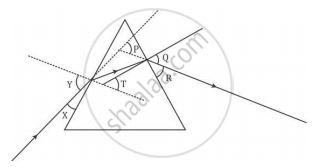
In this diagram the angle of incidence, the angle of emergence and the angle of deviation respectively are (select the correct option):
(A) X, R and T
(B) Y, Q and T
(C) X, Q and P
(D) Y, Q and P
In the following ray diagram the correctly marked angle are:

(a) ∠i and ∠e
(b) ∠A and ∠D
(c) ∠i, ∠e and ∠D
(d) ∠r, ∠A and ∠D
When a ray of light enters a prism, it bends ______ the normal; as it leaves the prism, it bends ______ the normal.
Describe how you could demonstrate that white light is composed of a number of colours.
What do you understand by the term spectrum? Name the various colours present in the spectrum of sunlight.
In the spectrum of white light by a prism, the colour at the extreme end opposite to the base of prism is ______.
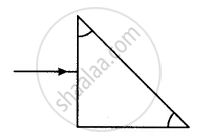
In the diagram, a narrow beam of white light is incident on a right-angled isosceles prism. The critical angle of the material of prism for the yellow colour of white light is 45°. Complete the diagram to show the path of blue, yellow, and red colours of white light till they emerge out of the prism.
The dispersive powers of flint glass and crown glass are 0.053 and 0.034, respectively and their mean refractive indices are 1.68 and 1.53 for white light. Calculate the angle of the flint glass prism required to form an achromatic combination with a crown glass prism of refracting angle 4°:
dispersive power of crown glass? Given that µv = 1.5230, µr = 1.5145
A prism of refractive index `sqrt2` and refracting angle A produces minimum deviation δm of a ray on one face at an angle of incidence 45°, The values of A and δm are, respectively ______.
