Advertisements
Advertisements
प्रश्न
- A beam of monochromatic light undergoes minimum deviation through an equiangular prism, how does the beam pass through the prism, with respect to its base?
- If white light is used in the same way as in part (a) above, what change do you expect in the emergent beam?
- What conclusion do you draw about the nature of white light in part (b)?
Advertisements
उत्तर
- The beam of light pass parallel to the base.
- White light splits into its constituent colours i.e., spectrum is formed.
- White light is Polychromatic.
APPEARS IN
संबंधित प्रश्न
Why do the component colours of incident white light split into a spectrum while passing through a glass prism, explain
Study the following ray diagram:
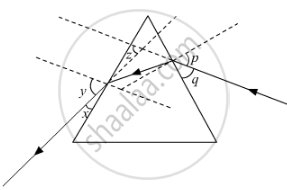
In this diagram, the angle of incidence, the angle of emergence and the angle of deviation respectively have been represented by
(A) y, p, z
(B) x, q, z
(C) p, y, z
(D) p, z, y
When a ray of light enters a prism, it bends ______ the normal; as it leaves the prism, it bends ______ the normal.
Draw a diagram to show how white light can be dispersed into a spectrum by using a glass prism. Mark the various colours of the spectrum.
What is a rainbow?
Explain the cause of dispersion of white light through a prism.
In the spectrum of white light by a prism, the colour at the extreme end opposite to the base of prism is ______.
What do you understand by spectrum? Name the seven prominent colours in order, as obtained in the spectrum of white light.
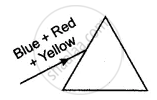
In the figure, a beam of light consisting of three colours blue, red, and yellow is incident on a prism and on a rectangular glass block respectively. Complete the diagram by drawings of the refracted and emergent rays.
The phenomena of light involved in the formation of rainbow are ______.
