Advertisements
Advertisements
प्रश्न
In the following diagram, the path of a ray of light passing through a glass prism is shown:
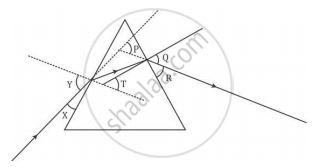
In this diagram the angle of incidence, the angle of emergence and the angle of deviation respectively are (select the correct option):
(A) X, R and T
(B) Y, Q and T
(C) X, Q and P
(D) Y, Q and P
Advertisements
उत्तर
The angle made by the incident ray with the normal to the first face of the prism is called incident angle, which is angle Y here.
The angle made by the emergent ray with the normal to the surface when it comes out from the prism after refraction is called emergent angle, which is angle Q here.
The angle between the incident ray and the emergent ray is called angle of deviation, which is angle P here.
Hence, the correct option is D.
APPEARS IN
संबंधित प्रश्न
The property of splitting of white light into its seven constituent colours is known as
Explain briefly, with the help of a neat labelled diagram, how white light gets dispersed by a prism. On which surface of a prism, there is both dispersion and deviation of light, and on which surface of the prism, there is only deviation of light ?
- A beam of monochromatic light undergoes minimum deviation through an equiangular prism, how does the beam pass through the prism, with respect to its base?
- If white light is used in the same way as in part (a) above, what change do you expect in the emergent beam?
- What conclusion do you draw about the nature of white light in part (b)?
What do you understand by the term spectrum?
In an experiment to trace the path of a ray of light through a glass prism for different values of angle of incidence a student would find that the emergent ray:
(A) is parallel to the incident ray
(B) perpendicular to the incident ray
(C) is parallel to the refracted ray
(D) bends at an angle to the direction of incident ray
Answer the following:
What do you mean by dispersion? Name the different colours of light in the proper sequence in the spectrum of light.
State two properties of ultraviolet radiation which differ from visible light.
Suggest one way, in each case, by which we can detect the presence of Infrared radiations.
The splitting of white light in to seven colors is called ______.
The dispersive powers of flint glass and crown glass are 0.053 and 0.034, respectively and their mean refractive indices are 1.68 and 1.53 for white light. Calculate the angle of the flint glass prism required to form an achromatic combination with a crown glass prism of refracting angle 4°:
