Advertisements
Advertisements
प्रश्न
A beam of white light falls on a glass prism. The colour of light which undergoes the least bending on passing through the glass prism is:
(a) violet
(b) red
(c) green
(d) blue
Advertisements
उत्तर
red
The colour red undergoes the least bending on passing through the glass prism as it has longest wavelength.
APPEARS IN
संबंधित प्रश्न
A student traces the path of a ray of light through a triangular glass prism for different values of angle of incidence. On analyzing the ray diagrams, which one of the following conclusions is he likely to draw?
(A) The emergent ray is parallel to the incident ray.
(B) The emergent ray bends at an angle to the direction of the incident ray.
(C) The emergent ray and the refracted ray are at right angles to each other.
(D) The emergent ray is perpendicular to the incident ray.
Why do the component colours of incident white light split into a spectrum while passing through a glass prism, explain
Define the term dispersion of white light.
When a beam of white light is passed through a prism, it splits to form lights of seven colours. Is it possible to recombine the lights of seven colours to obtain the white light again? Explain your answer.
Make two diagrams to explain refraction and dispersion.
Which of the following colour of white light has the least wavelength?
(a) red
(b) orange
(c) violet
(d) blue
Out of the following, the colour of light having the maximum wavelength is:
(a) violet
(b) indigo
(c) green
(d) orange
What do you understand by the term spectrum? Name the various colours present in the spectrum of sunlight.
You are given a disc divided into seven sectors with colours violet, indigo, blue, green, yellow, orange and red in them. What would be its colour when it is rotated rapidly?
When a white light ray falls on a prism, the ray at its first surface suffers ______.
While performing the experiment to trace the path of a ray of light passing through a glass prism, four students marked the incident ray and the emergent ray in their diagrams in the manner shown below. 
(A) I
(B) II
(C) III
(D) IV
In an experiment to trace the path of a ray of light through a glass prism for different values of angle of incidence a student would find that the emergent ray:
(A) is parallel to the incident ray
(B) perpendicular to the incident ray
(C) is parallel to the refracted ray
(D) bends at an angle to the direction of incident ray
A glass prism is able to produce the spectrum when white light passes through it, but a glass slab doesn’t produce any spectrum. Explain why it is so.
The wavelength range of white light is ______.
Write the range of wavelength of the infrared spectrum.
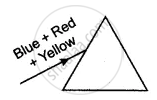
In the figure, a beam of light consisting of three colours blue, red, and yellow is incident on a prism and on a rectangular glass block respectively. Complete the diagram by drawings of the refracted and emergent rays.
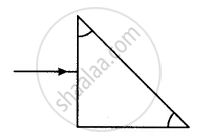
In the diagram, a narrow beam of white light is incident on a right-angled isosceles prism. The critical angle of the material of prism for the yellow colour of white light is 45°. Complete the diagram to show the path of blue, yellow, and red colours of white light till they emerge out of the prism.
Assertion: We can see the rainbow in the sky when the rain starts falling after a spell of bright sunlight.
Reason: The rainbow is formed due to the dispersion of light.
The dispersive powers of flint glass and crown glass are 0.053 and 0.034, respectively and their mean refractive indices are 1.68 and 1.53 for white light. Calculate the angle of the flint glass prism required to form an achromatic combination with a crown glass prism of refracting angle 4°:
In the following diagram showing dispersion of white light by a glass prism, the colours 'P' and 'Q’ respectively are:

