Advertisements
Advertisements
प्रश्न
A glass prism is able to produce the spectrum when white light passes through it, but a glass slab doesn’t produce any spectrum. Explain why it is so.
Advertisements
उत्तर
The two faces of a glass prism are at an angle (angle of prism) with each other. Therefore, the angle of incidence and the angle of emergence of a light ray become different in the case of a prism. Therefore, when white light gets dispersed after entering a prism, its component colours spread more after refracting through the opposite face of the prism.
In the case of a glass slab, the two opposite faces of the slab are parallel to each other. Therefore, the angle of incidence and the angle of emergence of a light ray remain the same for a glass slab. Therefore, the dispersed light rays combine to form white light after refracting through the second face of the glass slab.
APPEARS IN
संबंधित प्रश्न
Draw a ray diagram to explain the term angle of deviation.
When a beam of white light is passed through a prism, it splits to form lights of seven colours. Is it possible to recombine the lights of seven colours to obtain the white light again? Explain your answer.
In the figure given alongside, a narrow beam of white light is shown to pass through a triangular glass prism. After passing through the prism, it produces a spectrum YX on the screen.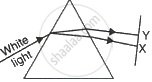
- State the colour seen
- at X, and
- at Y.
- Why do different colours of white light bend through different angles with respect to the incident beam of light?
Complete the ray diagram given below to show the nature of light produced on the screen.
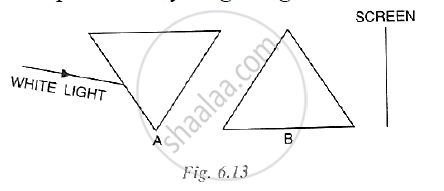
In the spectrum of white light by a prism, the colour at the extreme end opposite to the base of prism is ______.
How can the presence of ultraviolet radiation be detected?
Write the range of wavelength of the ultraviolet spectrum.
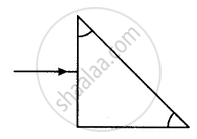
In the diagram, a narrow beam of white light is incident on a right-angled isosceles prism. The critical angle of the material of prism for the yellow colour of white light is 45°. Complete the diagram to show the path of blue, yellow, and red colours of white light till they emerge out of the prism.
Assertion: We can see the rainbow in the sky when the rain starts falling after a spell of bright sunlight.
Reason: The rainbow is formed due to the dispersion of light.
