Advertisements
Advertisements
Question
A glass prism is able to produce the spectrum when white light passes through it, but a glass slab doesn’t produce any spectrum. Explain why it is so.
Advertisements
Solution
The two faces of a glass prism are at an angle (angle of prism) with each other. Therefore, the angle of incidence and the angle of emergence of a light ray become different in the case of a prism. Therefore, when white light gets dispersed after entering a prism, its component colours spread more after refracting through the opposite face of the prism.
In the case of a glass slab, the two opposite faces of the slab are parallel to each other. Therefore, the angle of incidence and the angle of emergence of a light ray remain the same for a glass slab. Therefore, the dispersed light rays combine to form white light after refracting through the second face of the glass slab.
APPEARS IN
RELATED QUESTIONS
Draw a ray diagram to show the dispersion of white light.
In the figure given alongside, a narrow beam of white light is shown to pass through a triangular glass prism. After passing through the prism, it produces a spectrum YX on the screen.
Why do different colours of white light bend through different angles with respect to the incident beam of light?
A ray of light moving from an optically rarer to a denser medium
In the spectrum of white light by a prism, the colour at the extreme end opposite to the base of prism is ______.
In an experiment to trace the path of a ray of light through a glass prism for different values of angle of incidence a student would find that the emergent ray:
(A) is parallel to the incident ray
(B) perpendicular to the incident ray
(C) is parallel to the refracted ray
(D) bends at an angle to the direction of incident ray
A student has to trace the path of a ray of light through a glass prism. List four precautions he should observe for better results.
Sunlight entering through a narrow aperture falls on a prism. Draw a neat labelled ray diagram to show the formation of the spectrum on a screen. Name the colour obtained nearer the base of the prism.
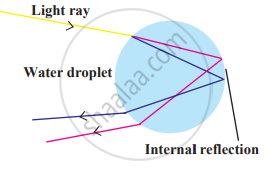
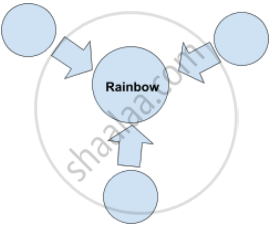
Rainbow is a beautiful natural phenomenon. It is the combined effect of a natural three processes together produced by light. Write it into the circle.
What is a rainbow?
