Advertisements
Advertisements
प्रश्न
A glass prism is able to produce the spectrum when white light passes through it, but a glass slab doesn’t produce any spectrum. Explain why it is so.
Advertisements
उत्तर
The two faces of a glass prism are at an angle (angle of prism) with each other. Therefore, the angle of incidence and the angle of emergence of a light ray become different in the case of a prism. Therefore, when white light gets dispersed after entering a prism, its component colours spread more after refracting through the opposite face of the prism.
In the case of a glass slab, the two opposite faces of the slab are parallel to each other. Therefore, the angle of incidence and the angle of emergence of a light ray remain the same for a glass slab. Therefore, the dispersed light rays combine to form white light after refracting through the second face of the glass slab.
APPEARS IN
संबंधित प्रश्न
The path of a ray of light passing through a glass prism is shown below:
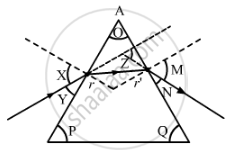
In this diagram, the angle of prism, angle of incidence, angle of emergence and angle of deviation, respectively, have been represented by:
(A) O, Y, Z and N,
(B) P, Y, M and Z,
(C) O, X, M and Z,
(D) P, X, Z and N.
Study the following ray diagram:
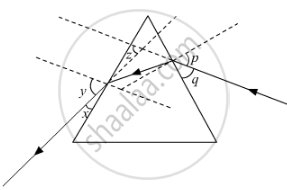
In this diagram, the angle of incidence, the angle of emergence and the angle of deviation respectively have been represented by
(A) y, p, z
(B) x, q, z
(C) p, y, z
(D) p, z, y
When a ray of light enters a prism, it bends ______ the normal; as it leaves the prism, it bends ______ the normal.
In the figure given alongside, a narrow beam of white light is shown to pass through a triangular glass prism. After passing through the prism, it produces a spectrum YX on the screen.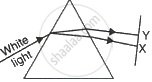
- State the colour seen
- at X, and
- at Y.
- Why do different colours of white light bend through different angles with respect to the incident beam of light?
Describe how you could demonstrate that white light is composed of a number of colours.
Out of air and glass, which is optically rarer? Give reason.
Define the term dispersion of light.
The wavelength range of white light is ______.
Say TRUE or FALSE
After passing through a prism, white light splits into a band of seven colours
When white light enters a glass prism from the air, the angle of deviation is least for ____________.
