Advertisements
Advertisements
Question
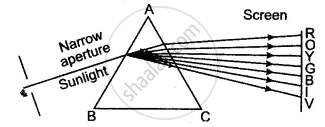
Sunlight entering through a narrow aperture falls on a prism. Draw a neat labelled ray diagram to show the formation of the spectrum on a screen. Name the colour obtained nearer the base of the prism.
Advertisements
Solution
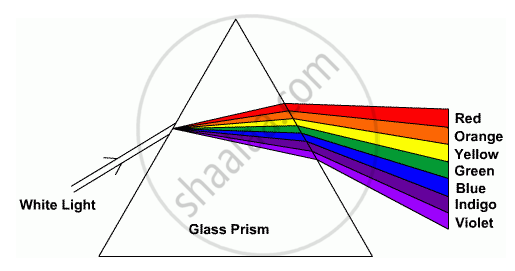
The labelled ray diagram showing the formation of the spectrum of sunlight on a screen is given below. The colour obtained nearer the base of the prism is violet.
RELATED QUESTIONS
A narrow beam PQ of white light is passing through a glass prism ABC as shown in the diagram.

Trace it on your answer sheet and show the path of the emergent beam as observed on the screen DE.
(i) Write the name and cause of the phenomenon observed.
(ii) Where else in nature is this phenomenon observed?
(iii) Based on this observation, state the conclusion which can be drawn about the constituents of white light.
When a beam of white light is passed through a prism, it splits to form lights of seven colours. Is it possible to recombine the lights of seven colours to obtain the white light again? Explain your answer.
If white light is used in same way what change is expected in the emergent beam?
What is the cause of the dispersion of white light through a glass prism? Draw a ray diagram to show the path of light when two identical glass prisms are arranged together in an inverted position with respect to each other and a narrow beam of white light is allowed to fall obliquely on one of the faces of the prisms.
Write the range of wavelength of the ultraviolet spectrum.
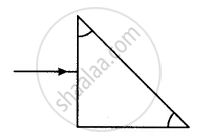
In the diagram, a narrow beam of white light is incident on a right-angled isosceles prism. The critical angle of the material of prism for the yellow colour of white light is 45°. Complete the diagram to show the path of blue, yellow, and red colours of white light till they emerge out of the prism.
Say TRUE or FALSE
After passing through a prism, white light splits into a band of seven colours
What is dispersion? Explain in detail.
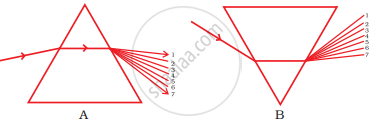
State the correct sequence (1-7) of colours in the spectrum formed by the prisms A and B, shown in the following figure.
Which one of the following is involved for the formation of rainbow in the sky?
