Advertisements
Advertisements
Question
If white light is used in same way what change is expected in the emergent beam?
Advertisements
Solution
The white light shall split into its constituent colours and a spectrum shall be formed.
APPEARS IN
RELATED QUESTIONS
Describe an activity to show that colours of white light splitted by a glass prism can be recombined to get white light by another identical glass prism. Also draw ray diagram to show the recombination of the spectrum of white light.
Study the following ray diagram:
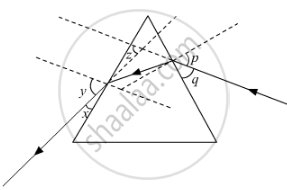
In this diagram, the angle of incidence, the angle of emergence and the angle of deviation respectively have been represented by
(A) y, p, z
(B) x, q, z
(C) p, y, z
(D) p, z, y
Describe how you could demonstrate that white light is composed of a number of colours.
A beam of white light falls on a glass prism. The colour of light which undergoes the least bending on passing through the glass prism is:
(a) violet
(b) red
(c) green
(d) blue
Out of the following, the colour of light having the maximum wavelength is:
(a) violet
(b) indigo
(c) green
(d) orange
The diagram below shows the path taken by a narrow beam of yellow monochromatic light passing through an equiangular glass prism. If the yellow light is replaced by a narrow beam of white light incident at the same angle, draw another diagram to show the passage of white light through the prism and label it to show the effect of prism on the white light.

In which of the following four diagrams is the correct path of a ray of light passing through a glass prism shown ?
While performing the experiment to trace the path of a ray of light passing through a glass prism, four students marked the incident ray and the emergent ray in their diagrams in the manner shown below. 
(A) I
(B) II
(C) III
(D) IV
What is Newton’s disc?
When sunlight passes through water droplets in the atmosphere it gets dispersed into its constituent colours forming a rainbow. A similar phenomenon is observed when white light passes through a prism.
Instead of sunlight, a green-coloured ray is passed through a glass prism. What will be the colour of the emergent ray?
