Advertisements
Advertisements
Questions
If a monochromatic beam of light undergoes minimum deviation through an equiangular prism, how does the beam pass through the prism, with respect to its base?
A beam of monochromatic light undergoes minimum deviation through an equiangular prism. How does the beam pass through the prism with respect to its base ?
Advertisements
Solution
It passes parallel with respect to the base of the prism.
APPEARS IN
RELATED QUESTIONS
- A ray of white light breaks up into its components while passing through a glass prism. Draw a ray diagram to show the path of rays.
- Mark the least deviated colour in your diagram.
- Why do different coloured rays deviate differently in a prism?
As light rays pass from air into a glass prism, are they refracted towards or away from the normal?
What are the seven colours seen in a rainbow?
Which is optically denser: water or air? Give reason
Complete the ray diagram given below to show the nature of light produced on the screen.
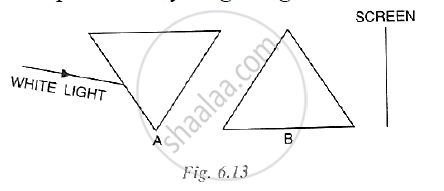
In the spectrum of white light by a prism, the colour at the extreme end opposite to the base of prism is ______.
Which characteristic property of light is responsible for the blue colour of the sky?
State two properties of ultraviolet radiation which differ from visible light.
Write the range of wavelength of the visible spectrum.
When sunlight passes through water droplets in the atmosphere it gets dispersed into its constituent colours forming a rainbow. A similar phenomenon is observed when white light passes through a prism.
Instead of sunlight, a green-coloured ray is passed through a glass prism. What will be the colour of the emergent ray?
