Advertisements
Advertisements
प्रश्न
If a monochromatic beam of light undergoes minimum deviation through an equiangular prism, how does the beam pass through the prism, with respect to its base?
A beam of monochromatic light undergoes minimum deviation through an equiangular prism. How does the beam pass through the prism with respect to its base ?
Advertisements
उत्तर
It passes parallel with respect to the base of the prism.
APPEARS IN
संबंधित प्रश्न
What acts as tiny prisms in the formation of a rainbow?
The splitting of white light into its constituent colours is called .............
How does the speed of light determine the optical density of a medium?
Out of air and glass, which is optically rarer? Give reason.
Explain briefly, with the help of a neat labelled diagram, how white light gets dispersed by a prism. On which surface of a prism, there is both dispersion and deviation of light, and on which surface of the prism, there is only deviation of light ?
In the spectrum of white light by a prism, the colour at the extreme end opposite to the base of prism is ______.
The wavelengths of violet and red light are 4000 Å and 8000 Å respectively. Which of the two has the higher frequency?
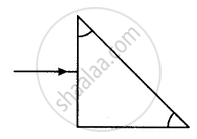
In the diagram, a narrow beam of white light is incident on a right-angled isosceles prism. The critical angle of the material of prism for the yellow colour of white light is 45°. Complete the diagram to show the path of blue, yellow, and red colours of white light till they emerge out of the prism.
Match the Columns:
| Column ‘A’ | Column ‘B’ |
| The wavelength of red light | (a) 600 nm |
| (b) 700 nm | |
| (c) 500 nm |
When sunlight passes through water droplets in the atmosphere it gets dispersed into its constituent colours forming a rainbow. A similar phenomenon is observed when white light passes through a prism.
Instead of sunlight, a green-coloured ray is passed through a glass prism. What will be the colour of the emergent ray?
