Advertisements
Advertisements
Question
When sunlight passes through water droplets in the atmosphere it gets dispersed into its constituent colours forming a rainbow. A similar phenomenon is observed when white light passes through a prism.
Instead of sunlight, a green-coloured ray is passed through a glass prism. What will be the colour of the emergent ray?
Advertisements
Solution
The colour of the emergent ray will be green. A prism does not change the colour of light. It simply disperses white light into its constituent colours.
APPEARS IN
RELATED QUESTIONS
In the following diagram the correctly marked angles are :

(a) ∠A and ∠e
(b) ∠i, ∠A and ∠D
(c) ∠A ∠r and ∠e
(b) ∠A ∠r and ∠D
Define the term dispersion of white light.
Name the process which is involved in the formation of a rainbow.
Define the term dispersion of light.
What do you understand by the term spectrum?
In the following diagram, the correctly marked angles are
(A) All
(B) Only ∠i and ∠A
(C) ∠i, ∠r and ∠A
(D) ∠i, ∠A and ∠D
An object is placed in front of a converging lens and in front of a diverging lens as in fig.
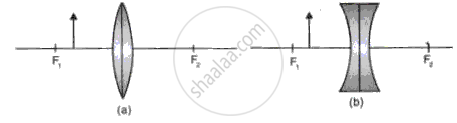
(a)Complete the ray diagram to obtain an image.
(b)Compare the nature of image formed by both the lenses in the above case.
Draw a labelled diagram: Dispersion of light through a prism.
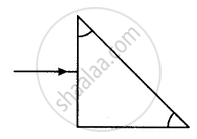
In the diagram, a narrow beam of white light is incident on a right-angled isosceles prism. The critical angle of the material of prism for the yellow colour of white light is 45°. Complete the diagram to show the path of blue, yellow, and red colours of white light till they emerge out of the prism.
Why do we see a rainbow in the sky only after rainfall?
