Advertisements
Advertisements
Question
When sunlight passes through water droplets in the atmosphere it gets dispersed into its constituent colours forming a rainbow. A similar phenomenon is observed when white light passes through a prism.
Which colour will show the maximum angle of deviation and which colour will show the minimum angle of deviation?
Advertisements
Solution
Violet shows the maximum angle of deviation and red shows the minimum angle of deviation.
APPEARS IN
RELATED QUESTIONS
Draw a ray diagram to explain the term angle of deviation.
In the formation of spectrum of white light by a prism:
which colour is deviated most?
What is spectrum?
A beam of white light is shone onto a glass prism. The light cannot be:
(a) deviated
(b) dispersed
(c) focused
(d) refracted
Out of air and glass, which is optically rarer? Give reason.
An object is placed in front of a converging lens and in front of a diverging lens as in fig.
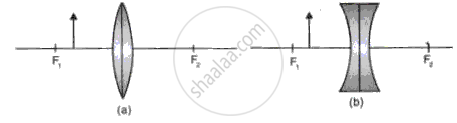
(a)Complete the ray diagram to obtain an image.
(b)Compare the nature of image formed by both the lenses in the above case.
A wave has wavelength 50Å of State its one use.
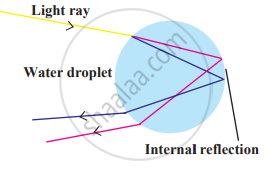
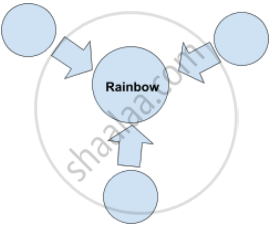
Rainbow is a beautiful natural phenomenon. It is the combined effect of a natural three processes together produced by light. Write it into the circle.
A prism of refractive index `sqrt2` and refracting angle A produces minimum deviation δm of a ray on one face at an angle of incidence 45°, The values of A and δm are, respectively ______.
