Advertisements
Advertisements
Question
A beam of white light is shone onto a glass prism. The light cannot be:
(a) deviated
(b) dispersed
(c) focused
(d) refracted
Advertisements
Solution
focussed
A beam of white light when shone on to a glass prism can be deviated, dispersed or refracted, but it cannot be focussed.
APPEARS IN
RELATED QUESTIONS
After tracing the path of a ray of light through a glass prism a student marked the angle of incidence (∠i), angle of refraction (∠r) angle of emergence (∠e) and the angle of deviation (∠D) as shown in the diagram. The correctly marked angles are :

(A) ∠i and ∠r
(B) ∠i and ∠e
(C) ∠i, ∠e and ∠D
(D) ∠i, ∠r and ∠e
Study the following ray diagram:
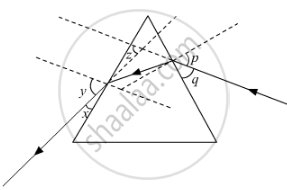
In this diagram, the angle of incidence, the angle of emergence and the angle of deviation respectively have been represented by
(A) y, p, z
(B) x, q, z
(C) p, y, z
(D) p, z, y
As light rays emerge from a glass prism into air, are they refracted towards or away from the normal?
In the figure given alongside, a narrow beam of white light is shown to pass through a triangular glass prism. After passing through the prism, it produces a spectrum YX on the screen.
Why do different colours of white light bend through different angles with respect to the incident beam of light?
Make two diagrams to explain refraction and dispersion.
The splitting up of white light into seven colours on passing through a glass prism is called ______.
The coloured light having the maximum speed in glass prism is ______.
When white light passes through a prism, it ............
The speed of light in air or vacuum is
A ray of light moving from an optically rarer to a denser medium
The property of splitting of white light into its seven constituent colours is known as
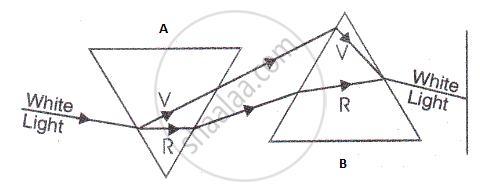
Draw a labeled ray diagram to illustrate the dispersion of a narrow beam of white light when it passes through a glass prism.
Complete the ray diagram given below to show the nature of light produced on the screen.
The completed ray diagram is as shown below:
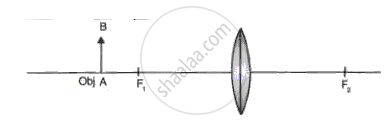
An object AB is placed in front of a convex lens as shown in fig. 4. Complete the ray diagram and obtain the image formed and state the nature of the image.
What is the cause of the dispersion of white light through a glass prism? Draw a ray diagram to show the path of light when two identical glass prisms are arranged together in an inverted position with respect to each other and a narrow beam of white light is allowed to fall obliquely on one of the faces of the prisms.
Which characteristic property of light is responsible for the blue colour of the sky?
How can the presence of ultraviolet radiation be detected?
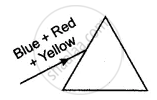
In the figure, a beam of light consisting of three colours blue, red, and yellow is incident on a prism and on a rectangular glass block respectively. Complete the diagram by drawings of the refracted and emergent rays.
Say TRUE or FALSE
Rainbow is formed by dispersion of which light by water drops
dispersive power of crown glass? Given that µv = 1.5230, µr = 1.5145
