Advertisements
Advertisements
प्रश्न
A beam of white light is shone onto a glass prism. The light cannot be:
(a) deviated
(b) dispersed
(c) focused
(d) refracted
Advertisements
उत्तर
focussed
A beam of white light when shone on to a glass prism can be deviated, dispersed or refracted, but it cannot be focussed.
APPEARS IN
संबंधित प्रश्न
A narrow beam PQ of white light is passing through a glass prism ABC as shown in the diagram.

Trace it on your answer sheet and show the path of the emergent beam as observed on the screen DE.
(i) Write the name and cause of the phenomenon observed.
(ii) Where else in nature is this phenomenon observed?
(iii) Based on this observation, state the conclusion which can be drawn about the constituents of white light.
In the following ray diagram the correctly marked angle are:

(a) ∠i and ∠e
(b) ∠A and ∠D
(c) ∠i, ∠e and ∠D
(d) ∠r, ∠A and ∠D
The path of a ray of light passing through a glass prism is shown below:
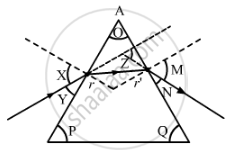
In this diagram, the angle of prism, angle of incidence, angle of emergence and angle of deviation, respectively, have been represented by:
(A) O, Y, Z and N,
(B) P, Y, M and Z,
(C) O, X, M and Z,
(D) P, X, Z and N.
Why do the component colours of incident white light split into a spectrum while passing through a glass prism, explain
In the formation of spectrum of white light by a prism:
- which colour is deviated least?
- which colour is deviated most?
Describe how you could demonstrate that white light is composed of a number of colours.
How could you show that the colours of the spectrum combine to give white light?
What are the seven colours seen in a rainbow?
The splitting up of white light into seven colours on passing through a glass prism is called ______.
The coloured light having the maximum speed in glass prism is ______.
A ray of light moving from an optically rarer to a denser medium
State the speed of light in (a) air, (b) water, and (c) glass
Explain the cause of dispersion of white light through a prism.
A ray of white light is passed through a glass prism and a spectrum is obtained on a screen.
- Name the seven colours of the spectrum in order.
- Do the colours have the same width in the spectrum?
- Which of the colour of the spectrum of white light deviates (i) the most, (ii) the least?
Make the correct choice for each of the following:
Which one of the following Fig correctly shows the path of the ray through the glass block?
A wave has wavelength 50Å of State its one use.
Distinguish between an impure spectrum and a pure spectrum.
Write the range of wavelength of the infrared spectrum.
Observe the given figure and answer the following questions.
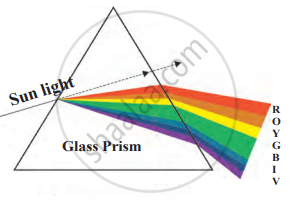
- Which colour light rays bend most?
- Which colour light rays bend least.
- What is the wavelength of violet light rays?
Assertion: We can see the rainbow in the sky when the rain starts falling after a spell of bright sunlight.
Reason: The rainbow is formed due to the dispersion of light.
