Advertisements
Advertisements
प्रश्न
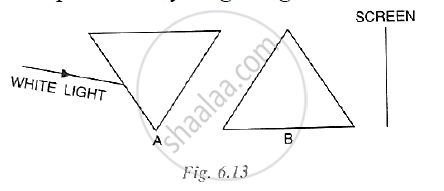
How could you show that the colours of the spectrum combine to give white light?
Advertisements
उत्तर
We know that a spectrum of colours is formed when a beam of white light is passed through a transparent glass prism. These colours can be recombined to give white light again. This is achieved by placing another glass prism upside down behind the first prism. A patch of white light is obtained on a screen placed behind the second prism because the refraction produced by the second prism is equal and opposite to the refraction produced by the first prism.
APPEARS IN
संबंधित प्रश्न
A student is observing a diagram showing the path of a ray of light passing through a glass prism. He would find that for all angles of incidence the ray of light bends:
When a ray of light enters a prism, it bends ______ the normal; as it leaves the prism, it bends ______ the normal.
In the figure given alongside, a narrow beam of white light is shown to pass through a triangular glass prism. After passing through the prism, it produces a spectrum YX on the screen.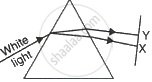
- State the colour seen
- at X, and
- at Y.
- Why do different colours of white light bend through different angles with respect to the incident beam of light?
Make two diagrams to explain refraction and dispersion.
Out of the following, the colour of light having the maximum wavelength is:
(a) violet
(b) indigo
(c) green
(d) orange
How does the speed of light determine the optical density of a medium?
- A beam of monochromatic light undergoes minimum deviation through an equiangular prism, how does the beam pass through the prism, with respect to its base?
- If white light is used in the same way as in part (a) above, what change do you expect in the emergent beam?
- What conclusion do you draw about the nature of white light in part (b)?
Complete the ray diagram given below to show the nature of light produced on the screen.
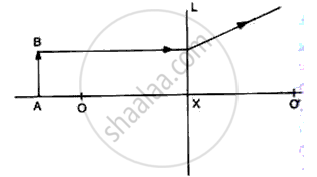
Refer to fig
(i) Name the lens L.
(ii) What are the points O, O' called?
(iii) Complete the diagram to form the image of the object AB.
(iv) Write three characteristics of the image.
Answer the following:
What do you mean by dispersion? Name the different colours of light in the proper sequence in the spectrum of light.
Which characteristic property of light is responsible for the blue colour of the sky?
Sunlight entering through a narrow aperture falls on a prism. Draw a neat labelled ray diagram to show the formation of the spectrum on a screen. Name the colour obtained nearer the base of the prism.
Match the Columns:
| Column ‘A’ | Column ‘B’ |
| The wavelength of red light | (a) 600 nm |
| (b) 700 nm | |
| (c) 500 nm |
Write an Explanation.
Critical angle
Observe the given figure and write appropriate phenomenon of light in the box.
Say TRUE or FALSE
Rainbow is formed by dispersion of which light by water drops
Which one of the following is involved for the formation of rainbow in the sky?
In dispersion, the color of light that will bend more is ______.
The dispersive powers of flint glass and crown glass are 0.053 and 0.034, respectively and their mean refractive indices are 1.68 and 1.53 for white light. Calculate the angle of the flint glass prism required to form an achromatic combination with a crown glass prism of refracting angle 4°:
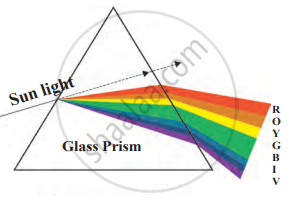
Observe the given diagram and answer the questions:
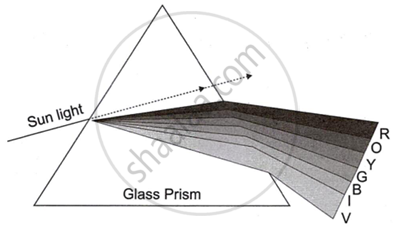
- Name the process shown in the figure.
- Name the colour that deviates the most.
- Name the colour that deviates the least.
- Name any one phenomenon in nature which is based on the above process.
- Define ‘spectrum’.
