Advertisements
Advertisements
प्रश्न
When a ray of light enters a prism, it bends ______ the normal; as it leaves the prism, it bends ______ the normal.
Advertisements
उत्तर
When a ray of light enters a prism, it bends towards the normal; as it leaves the prism, it bends away from the normal.
संबंधित प्रश्न
- A ray of white light breaks up into its components while passing through a glass prism. Draw a ray diagram to show the path of rays.
- Mark the least deviated colour in your diagram.
- Why do different coloured rays deviate differently in a prism?
As light rays pass from air into a glass prism, are they refracted towards or away from the normal?
As light rays emerge from a glass prism into air, are they refracted towards or away from the normal?
What happens when a ray of ordinary light is passed through a triangular glass prism?
Draw a diagram to show the refraction of light through a glass prism. On this diagram, mark
(i) incident ray
(ii) emergent ray, and
(iii) angle of deviation.
What acts as tiny prisms in the formation of a rainbow?
Why do you not see a spectrum of colours when light passes through a flat pane of glass?
The splitting of white light into its constituent colours is called .............
You are given a disc divided into seven sectors with colours violet, indigo, blue, green, yellow, orange and red in them. What would be its colour when it is rotated rapidly?
A ray of white light is passed through a glass prism and a spectrum is obtained on a screen.
- Name the seven colours of the spectrum in order.
- Do the colours have the same width in the spectrum?
- Which of the colour of the spectrum of white light deviates (i) the most, (ii) the least?
Complete the ray diagram given below to show the nature of light produced on the screen.
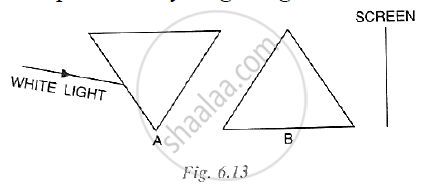
In an experiment to trace the path of a ray of light through a triangular glass prism, a student would observe that the emergent ray
(a) is parallel to the incident ray.
(b) is along the same direction of incident ray.
(c) gets deviated and bends towards the thinner part of the prism.
(d) gets deviated and bends towards the thicker part (base) of the prism.
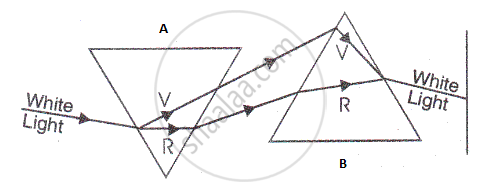
When we place a glass prism in the path of a narrow beam of white light a spectrum is obtained. What happens when a second identical prism is placed in an inverted position with respect to the first prism? Draw a labelled ray diagram to illustrate it.
If a monochromatic beam of light undergoes minimum deviation through an equiangular prism, how does the beam pass through the prism, with respect to its base?
Complete the ray diagram given below to show the nature of light produced on the screen.
The completed ray diagram is as shown below:
Make the correct choice for each of the following:
Which one of the following Fig correctly shows the path of the ray through the glass block?
The phenomenon of splitting of light into its component colours is ___________ .
How can the presence of ultraviolet radiation be detected?
Distinguish between an impure spectrum and a pure spectrum.
Suggest one way, in each case, by which we can detect the presence of Infrared radiations.
In the figure, a beam of light consisting of three colours blue, red, and yellow is incident on a prism and on a rectangular glass block respectively. Complete the diagram by drawings of the refracted and emergent rays.
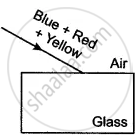
In the figure, a beam of light consisting of three colours blue, red, and yellow is incident on a prism and on a rectangular glass block respectively. Complete the diagram by drawings of the refracted and emergent rays.
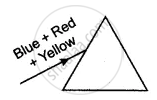
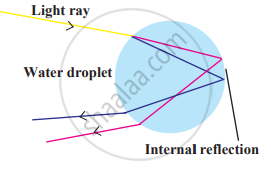
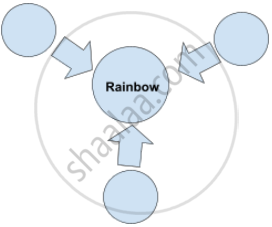
Rainbow is a beautiful natural phenomenon. It is the combined effect of a natural three processes together produced by light. Write it into the circle.
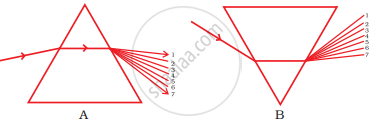
State the correct sequence (1-7) of colours in the spectrum formed by the prisms A and B, shown in the following figure.
Assertion: We can see the rainbow in the sky when the rain starts falling after a spell of bright sunlight.
Reason: The rainbow is formed due to the dispersion of light.
A prism of refractive index `sqrt2` and refracting angle A produces minimum deviation δm of a ray on one face at an angle of incidence 45°, The values of A and δm are, respectively ______.
When sunlight passes through water droplets in the atmosphere it gets dispersed into its constituent colours forming a rainbow. A similar phenomenon is observed when white light passes through a prism.
Instead of sunlight, a green-coloured ray is passed through a glass prism. What will be the colour of the emergent ray?
