Advertisements
Advertisements
प्रश्न
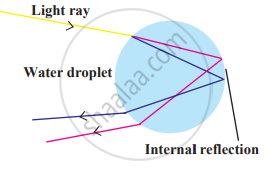
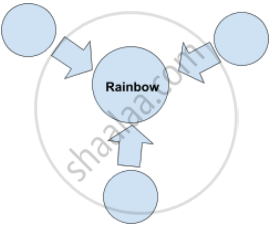
Rainbow is a beautiful natural phenomenon. It is the combined effect of a natural three processes together produced by light. Write it into the circle.
Advertisements
उत्तर
Rainbow-
- Refraction
- Dispersion
- Total internal reflection
APPEARS IN
संबंधित प्रश्न
A student traces the path of a ray of light through a triangular glass prism for different values of angle of incidence. On analyzing the ray diagrams, which one of the following conclusions is he likely to draw?
(A) The emergent ray is parallel to the incident ray.
(B) The emergent ray bends at an angle to the direction of the incident ray.
(C) The emergent ray and the refracted ray are at right angles to each other.
(D) The emergent ray is perpendicular to the incident ray.
Describe an activity to show that colours of white light splitted by a glass prism can be recombined to get white light by another identical glass prism. Also draw ray diagram to show the recombination of the spectrum of white light.
State the cause of dispersion of white light passing through a glass prism. How did Newton show that white light of sun contains seven colours using two identical glass prisms. Draw a ray diagram to show the path of light when two identical glass prisms are arranged together in inverted position with respect to each other and a narrow beam of white light is allowed to fall obliquely on one of the focus of the first prism.
The path of a ray of light passing through a glass prism is shown below:
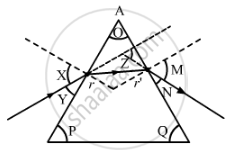
In this diagram, the angle of prism, angle of incidence, angle of emergence and angle of deviation, respectively, have been represented by:
(A) O, Y, Z and N,
(B) P, Y, M and Z,
(C) O, X, M and Z,
(D) P, X, Z and N.
When a beam of white light is passed through a prism, it splits to form lights of seven colours. Is it possible to recombine the lights of seven colours to obtain the white light again? Explain your answer.
What is spectrum?
Describe how you could demonstrate that white light is composed of a number of colours.
The coloured light having the maximum speed in glass prism is ______.
When white light passes through a prism, it ............
- A beam of monochromatic light undergoes minimum deviation through an equiangular prism, how does the beam pass through the prism, with respect to its base?
- If white light is used in the same way as in part (a) above, what change do you expect in the emergent beam?
- What conclusion do you draw about the nature of white light in part (b)?
While performing the experiment to trace the path of a ray of light passing through a glass prism, four students marked the incident ray and the emergent ray in their diagrams in the manner shown below. 
(A) I
(B) II
(C) III
(D) IV
If a monochromatic beam of light undergoes minimum deviation through an equiangular prism, how does the beam pass through the prism, with respect to its base?
Draw a labelled diagram: Dispersion of light through a prism.
Write three conditions necessary to obtain a pure spectrum on a screen. Name the instrument in which the conditions stated by you are fulfilled.
Distinguish between an impure spectrum and a pure spectrum.
Match the Columns:
| Column ‘A’ | Column ‘B’ |
| The wavelength of red light | (a) 600 nm |
| (b) 700 nm | |
| (c) 500 nm |
Draw a neat and labelled diagram for dispersion of light.
Which one of the following is involved for the formation of rainbow in the sky?
In the following diagram showing dispersion of white light by a glass prism, the colours 'P' and 'Q’ respectively are:

