Advertisements
Advertisements
प्रश्न
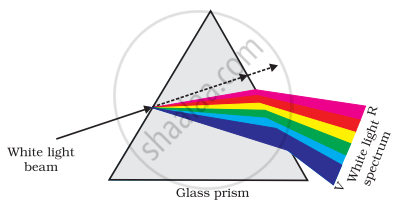
In the following diagram showing dispersion of white light by a glass prism, the colours 'P' and 'Q’ respectively are:

पर्याय
Red and Violet
Violet and Red
Red and Blue
Orange and Green
Advertisements
उत्तर
Violet and Red
Explanation:
The splitting of white light into its constituent colours is known as light dispersion. The spectrum is the band of seven colours produced by splitting white light. All of the constituent colours of white light have the same velocity in vacuum, but their velocity changes when they pass through a transparent 'medium' like a glass prism. Different colours are diverted by different angles on the prism's initial face. Violet's minimum speed is deviated by the maximum angle, whereas red's maximum speed is distorted by the minimum angle. As a result, the letters 'P' and 'Q' are violet and crimson, respectively.
संबंधित प्रश्न
Study the following ray diagram:
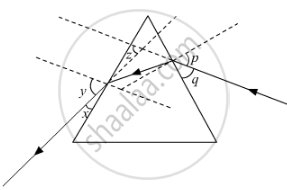
In this diagram, the angle of incidence, the angle of emergence and the angle of deviation respectively have been represented by
(A) y, p, z
(B) x, q, z
(C) p, y, z
(D) p, z, y
The colour of white light which suffers the maximum bending (or maximum refraction) on passing through a glass prism is:
(a) yellow
(b) orange
(c) red
(d) violet
State the speed of light in (a) air, (b) water, and (c) glass
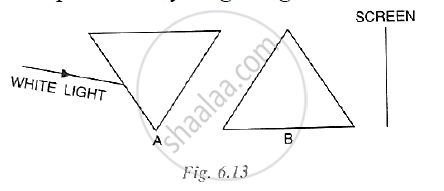
Complete the ray diagram given below to show the nature of light produced on the screen.
The frequency range of visible light is from 3.75 × 10¹⁴ Hz to 7.5 × 10¹⁴ Hz. Calculate its wavelength range. Take speed of light = 3 × 10⁸ m/s.
In an experiment to trace the path of a ray of light through a glass prism for different values of angle of incidence a student would find that the emergent ray:
(A) is parallel to the incident ray
(B) perpendicular to the incident ray
(C) is parallel to the refracted ray
(D) bends at an angle to the direction of incident ray
If white light is used in same way what change is expected in the emergent beam?
Which characteristic property of light is responsible for the blue colour of the sky?
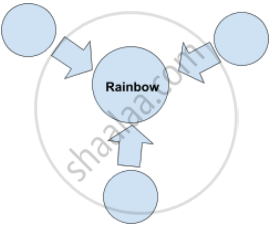
Rainbow is a beautiful natural phenomenon. It is the combined effect of a natural three processes together produced by light. Write it into the circle.
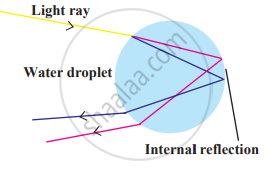
In dispersion, the color of light that will bend more is ______.
