Advertisements
Advertisements
Question
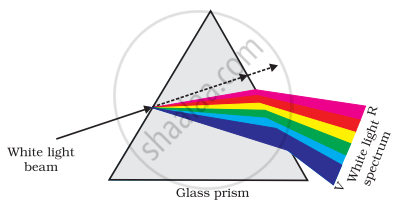
In the following diagram showing dispersion of white light by a glass prism, the colours 'P' and 'Q’ respectively are:

Options
Red and Violet
Violet and Red
Red and Blue
Orange and Green
Advertisements
Solution
Violet and Red
Explanation:
The splitting of white light into its constituent colours is known as light dispersion. The spectrum is the band of seven colours produced by splitting white light. All of the constituent colours of white light have the same velocity in vacuum, but their velocity changes when they pass through a transparent 'medium' like a glass prism. Different colours are diverted by different angles on the prism's initial face. Violet's minimum speed is deviated by the maximum angle, whereas red's maximum speed is distorted by the minimum angle. As a result, the letters 'P' and 'Q' are violet and crimson, respectively.
RELATED QUESTIONS
In the following diagram, the path of a ray of light passing through a glass prism is shown:
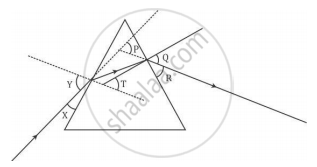
In this diagram the angle of incidence, the angle of emergence and the angle of deviation respectively are (select the correct option):
(A) X, R and T
(B) Y, Q and T
(C) X, Q and P
(D) Y, Q and P
When a beam of white light is passed through a prism, it splits to form lights of seven colours. Is it possible to recombine the lights of seven colours to obtain the white light again? Explain your answer.
The colour of white light which is deviated the maximum on passing through the glass prism is:
(a) blue
(b) indigo
(c) red
(d) orange
The diagram below shows the path taken by a narrow beam of yellow monochromatic light passing through an equiangular glass prism. If the yellow light is replaced by a narrow beam of white light incident at the same angle, draw another diagram to show the passage of white light through the prism and label it to show the effect of prism on the white light.

The frequency range of visible light is from 3.75 × 10¹⁴ Hz to 7.5 × 10¹⁴ Hz. Calculate its wavelength range. Take speed of light = 3 × 10⁸ m/s.
A wave has wavelength 50Å of State the speed in vacuum.
Write the range of wavelength of the visible spectrum.
Write the range of wavelength of the ultraviolet spectrum.
Write the range of wavelength of the infrared spectrum.
Write an Explanation.
Critical angle
