Advertisements
Advertisements
Question
In the following diagram, the path of a ray of light passing through a glass prism is shown:
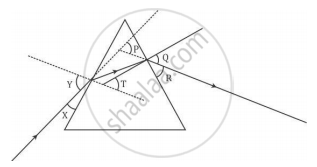
In this diagram the angle of incidence, the angle of emergence and the angle of deviation respectively are (select the correct option):
(A) X, R and T
(B) Y, Q and T
(C) X, Q and P
(D) Y, Q and P
Advertisements
Solution
The angle made by the incident ray with the normal to the first face of the prism is called incident angle, which is angle Y here.
The angle made by the emergent ray with the normal to the surface when it comes out from the prism after refraction is called emergent angle, which is angle Q here.
The angle between the incident ray and the emergent ray is called angle of deviation, which is angle P here.
Hence, the correct option is D.
APPEARS IN
RELATED QUESTIONS
Which of the following colour of white light is least deviated by the prism?
(a) green
(b) violet
(c) indigo
(d) yellow
The colour of white light which is deviated the maximum on passing through the glass prism is:
(a) blue
(b) indigo
(c) red
(d) orange
The splitting of white light into its constituent colours is called .............
In an experiment to trace the path of a ray of light through a glass prism for different values of angle of incidence a student would find that the emergent ray:
(A) is parallel to the incident ray
(B) perpendicular to the incident ray
(C) is parallel to the refracted ray
(D) bends at an angle to the direction of incident ray
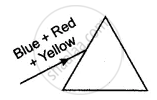
In the figure, a beam of light consisting of three colours blue, red, and yellow is incident on a prism and on a rectangular glass block respectively. Complete the diagram by drawings of the refracted and emergent rays.
Write an Explanation.
Critical angle
What is dispersion? Explain in detail.
Which of the following is a natural phenomenon which is caused by the dispersion of sunlight in the sky?
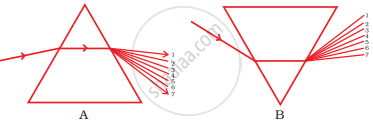
State the correct sequence (1-7) of colours in the spectrum formed by the prisms A and B, shown in the following figure.