Advertisements
Advertisements
Question
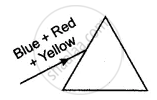
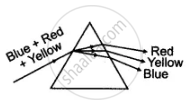
In the figure, a beam of light consisting of three colours blue, red, and yellow is incident on a prism and on a rectangular glass block respectively. Complete the diagram by drawings of the refracted and emergent rays.
Advertisements
Solution
The complete diagram is given below:
RELATED QUESTIONS
What is spectrum?
A ray of light moving from an optically rarer to a denser medium
What conclusion do you draw about the nature of white light in part (b)?
In the spectrum of white light by a prism, the colour at the extreme end opposite to the base of prism is ______.
The frequency range of visible light is from 3.75 × 10¹⁴ Hz to 7.5 × 10¹⁴ Hz. Calculate its wavelength range. Take speed of light = 3 × 10⁸ m/s.
The wavelength range of white light is ______.
Which characteristic property of light is responsible for the blue colour of the sky?
State two properties of ultraviolet radiation which differ from visible light.
State the colour which bends:
- The most.
- The least while passing through a glass prism.
