Advertisements
Advertisements
Question
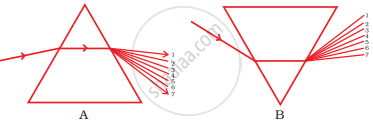
State the correct sequence (1-7) of colours in the spectrum formed by the prisms A and B, shown in the following figure.
Advertisements
Solution
In figure A and figure B
| Figure A | Colour | Figure B |
| 1 | Red | 7 |
| 2 | Orange | 6 |
| 3 | Yellow | 5 |
| 4 | Green | 4 |
| 5 | Blue | 3 |
| 6 | Indigo | 2 |
| 7 | Violet | 1 |
APPEARS IN
RELATED QUESTIONS
When a ray of light enters a prism, it bends ______ the normal; as it leaves the prism, it bends ______ the normal.
What acts as tiny prisms in the formation of a rainbow?
Name the process which is involved in the formation of a rainbow.
The colour of white light which suffers the maximum bending (or maximum refraction) on passing through a glass prism is:
(a) yellow
(b) orange
(c) red
(d) violet
Out of the following, the colour of light having the maximum wavelength is:
(a) violet
(b) indigo
(c) green
(d) orange
Complete the ray diagram given below to show the nature of light produced on the screen.
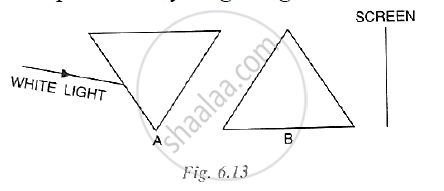
If white light is used in same way what change is expected in the emergent beam?
A wave has wavelength 50Å of name the wave.
Which of the following is a natural phenomenon which is caused by the dispersion of sunlight in the sky?
