Advertisements
Advertisements
Question
What acts as tiny prisms in the formation of a rainbow?
Advertisements
Solution
Raindrops act as tiny prisms in the formation of a rainbow.
APPEARS IN
RELATED QUESTIONS
After tracing the path of a ray of light through a glass prism a student marked the angle of incidence (∠i), angle of refraction (∠r) angle of emergence (∠e) and the angle of deviation (∠D) as shown in the diagram. The correctly marked angles are :

(A) ∠i and ∠r
(B) ∠i and ∠e
(C) ∠i, ∠e and ∠D
(D) ∠i, ∠r and ∠e
As light rays pass from air into a glass prism, are they refracted towards or away from the normal?
What is spectrum?
In the figure given alongside, a narrow beam of white light is shown to pass through a triangular glass prism. After passing through the prism, it produces a spectrum YX on the screen.
Why do different colours of white light bend through different angles with respect to the incident beam of light?
Why do you not see a spectrum of colours when light passes through a flat pane of glass?
Out of air and glass, which is optically rarer? Give reason.
The frequency range of visible light is from 3.75 × 10¹⁴ Hz to 7.5 × 10¹⁴ Hz. Calculate its wavelength range. Take speed of light = 3 × 10⁸ m/s.
Draw a labeled ray diagram to illustrate the dispersion of a narrow beam of white light when it passes through a glass prism.
If a monochromatic beam of light undergoes minimum deviation through an equiangular prism, how does the beam pass through the prism, with respect to its base?
If white light is used in same way what change is expected in the emergent beam?
A student has to trace the path of a ray of light through a glass prism. List four precautions he should observe for better results.
Which characteristic property of light is responsible for the blue colour of the sky?
How can the presence of ultraviolet radiation be detected?
Suggest one way, in each case, by which we can detect the presence of Infrared radiations.
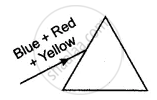
In the figure, a beam of light consisting of three colours blue, red, and yellow is incident on a prism and on a rectangular glass block respectively. Complete the diagram by drawings of the refracted and emergent rays.
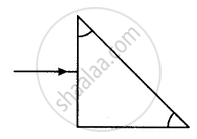
In the diagram, a narrow beam of white light is incident on a right-angled isosceles prism. The critical angle of the material of prism for the yellow colour of white light is 45°. Complete the diagram to show the path of blue, yellow, and red colours of white light till they emerge out of the prism.
The process of separation of light into its component colours while passing through a medium is called _______.
Observe the given figure and write appropriate phenomenon of light in the box.
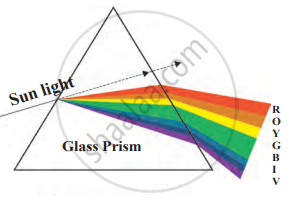
When white light enters a glass prism from the air, the angle of deviation is least for ____________.
Assertion: We can see the rainbow in the sky when the rain starts falling after a spell of bright sunlight.
Reason: The rainbow is formed due to the dispersion of light.
