Advertisements
Advertisements
Question
The frequency range of visible light is from 3.75 × 10¹⁴ Hz to 7.5 × 10¹⁴ Hz. Calculate its wavelength range. Take speed of light = 3 × 10⁸ m/s.
Advertisements
Solution
Frequency f = 3.75 × 10¹⁴ Hz
Velocity of light (C) = 3 × 10⁸ m/s
λ = `C/f`
= `(3 xx 10^8)/(3.75 xx 10^14)`
= `(3000 xx 10^5)/(375 xx 10^12)`
λ = `(8 xx 10^5)/(10^12)`
= `8 × 10^(5 - 12)`
= 8 × 10⁻⁷ m
= 8 × 10-7 × 1010 Å
= `8 × 10^(-7+10)`
= 8 × 10³ Å
Also, f = 7.5 × 10¹⁴ Hz
λ = `C/f`
= `(3 xx 10^8)/(7.5 xx 10^14)` m
= `(3 xx 10^8)/(75 xx 10^13)` m
= `(300)/(75) xx (10^6)/(10^13)`
= `4 × 10^(6 - 13)`m
= 4 × 10-7
= `4 xx 10^(-7 + 10)`
= 4 × 103
= 4000 Å
∴ Wavelength range of visible light is 4000 Å to 8000 Å
APPEARS IN
RELATED QUESTIONS
The path of a ray of light passing through a glass prism is shown below:
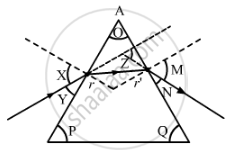
In this diagram, the angle of prism, angle of incidence, angle of emergence and angle of deviation, respectively, have been represented by:
(A) O, Y, Z and N,
(B) P, Y, M and Z,
(C) O, X, M and Z,
(D) P, X, Z and N.
The colour of white light which suffers the maximum bending (or maximum refraction) on passing through a glass prism is:
(a) yellow
(b) orange
(c) red
(d) violet
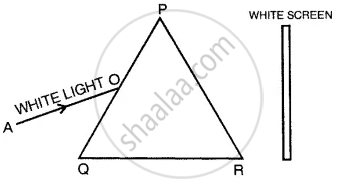
In figure AO is the ray of white light falling on a prism PQR. Complete the diagram till the light emerges out from the prism and falls on the screen.
Differentiate between a glass slab and a glass prism.
What is the cause of the dispersion of white light through a glass prism? Draw a ray diagram to show the path of light when two identical glass prisms are arranged together in an inverted position with respect to each other and a narrow beam of white light is allowed to fall obliquely on one of the faces of the prisms.
Write the range of wavelength of the visible spectrum.
Which of the following is a natural phenomenon which is caused by the dispersion of sunlight in the sky?
What is Newton’s disc?
Observe the given diagram and answer the questions:
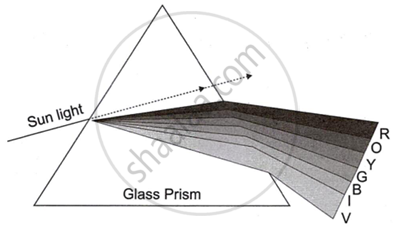
- Name the process shown in the figure.
- Name the colour that deviates the most.
- Name the colour that deviates the least.
- Name any one phenomenon in nature which is based on the above process.
- Define ‘spectrum’.
