Advertisements
Advertisements
प्रश्न
The frequency range of visible light is from 3.75 × 10¹⁴ Hz to 7.5 × 10¹⁴ Hz. Calculate its wavelength range. Take speed of light = 3 × 10⁸ m/s.
Advertisements
उत्तर
Frequency f = 3.75 × 10¹⁴ Hz
Velocity of light (C) = 3 × 10⁸ m/s
λ = `C/f`
= `(3 xx 10^8)/(3.75 xx 10^14)`
= `(3000 xx 10^5)/(375 xx 10^12)`
λ = `(8 xx 10^5)/(10^12)`
= `8 × 10^(5 - 12)`
= 8 × 10⁻⁷ m
= 8 × 10-7 × 1010 Å
= `8 × 10^(-7+10)`
= 8 × 10³ Å
Also, f = 7.5 × 10¹⁴ Hz
λ = `C/f`
= `(3 xx 10^8)/(7.5 xx 10^14)` m
= `(3 xx 10^8)/(75 xx 10^13)` m
= `(300)/(75) xx (10^6)/(10^13)`
= `4 × 10^(6 - 13)`m
= 4 × 10-7
= `4 xx 10^(-7 + 10)`
= 4 × 103
= 4000 Å
∴ Wavelength range of visible light is 4000 Å to 8000 Å
APPEARS IN
संबंधित प्रश्न
A beam of white light falls on a glass prism. The colour of light which undergoes the least bending on passing through the glass prism is:
(a) violet
(b) red
(c) green
(d) blue
What do you understand by the term spectrum? Name the various colours present in the spectrum of sunlight.
A wave has wavelength 50Å of name the wave.
Draw a labelled diagram: Dispersion of light through a prism.
What is the cause of the dispersion of white light through a glass prism? Draw a ray diagram to show the path of light when two identical glass prisms are arranged together in an inverted position with respect to each other and a narrow beam of white light is allowed to fall obliquely on one of the faces of the prisms.
Observe the given figure and answer the following questions.
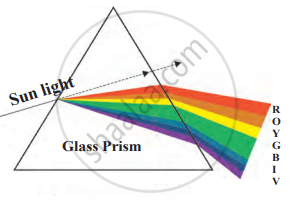
- Which colour light rays bend most?
- Which colour light rays bend least.
- What is the wavelength of violet light rays?
The splitting of white light in to seven colors is called ______.
Say TRUE or FALSE
After passing through a prism, white light splits into a band of seven colours
The phenomena of light involved in the formation of rainbow are ______.
During dispersion of white light by prism placed in air, for a particular value of angle of prism,
