Advertisements
Advertisements
प्रश्न
What is the cause of the dispersion of white light through a glass prism? Draw a ray diagram to show the path of light when two identical glass prisms are arranged together in an inverted position with respect to each other and a narrow beam of white light is allowed to fall obliquely on one of the faces of the prisms.
Advertisements
उत्तर
The dispersion of white light occurs because of the varying speeds of different colored lights through different media. White light consists of seven colors. The speeds of these colored lights are the same through the air. However, their speeds vary in other media. Therefore, when white light enters from air to a glass prism then its component colors get refracted by different angles. As a result, dispersion occurs.
A ray diagram to show the path of light when two identical glass prisms are arranged together in an inverted position with respect to each other and a narrow beam of white light is allowed to fall obliquely on one of the faces of the prisms is given below:

When white light of the Sun passes through the first prism, it gets dispersed into its seven component colors. When all the seven colors of the spectrum pass through the second prism then a beam of white light emerges from the other side of the second prism.
APPEARS IN
संबंधित प्रश्न
When white light passes through a prism, it ............
A ray of white light falls on a prism. Draw a ray diagram to show that the prism disperses the white light.
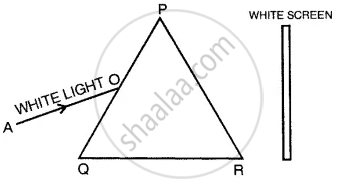
In figure AO is the ray of white light falling on a prism PQR. Complete the diagram till the light emerges out from the prism and falls on the screen.
You are given a disc divided into seven sectors with colours violet, indigo, blue, green, yellow, orange and red in them. What would be its colour when it is rotated rapidly?
In the following diagram, the correctly marked angles are
(A) All
(B) Only ∠i and ∠A
(C) ∠i, ∠r and ∠A
(D) ∠i, ∠A and ∠D
The wavelength range of white light is ______.
Which characteristic property of light is responsible for the blue colour of the sky?
Match the Columns:
| Column ‘A’ | Column ‘B’ |
| The wavelength of red light | (a) 600 nm |
| (b) 700 nm | |
| (c) 500 nm |
The process of separation of light into its component colours while passing through a medium is called _______.
______ colour is deviated the least in the spectrum of white light obtained with a glass prism.
