Advertisements
Advertisements
Question
What will happen if another similar glass prism is placed upside down behind the first prism?
Advertisements
Solution
If a second, similar glass prism is placed upside down behind the first prism, recombination of seven colours takes place and a patch of ordinary white light is obtained on a screen placed behind the second prism. The recombination of colours took place because the second prism was placed upside down, because of which the refraction produced by the second prism was equal and opposite to the refraction produced by the first prism.
APPEARS IN
RELATED QUESTIONS
In the following diagram, the path of a ray of light passing through a glass prism is shown:
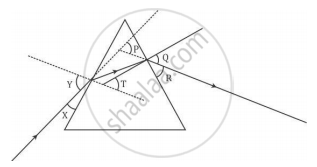
In this diagram the angle of incidence, the angle of emergence and the angle of deviation respectively are (select the correct option):
(A) X, R and T
(B) Y, Q and T
(C) X, Q and P
(D) Y, Q and P
The path of a ray of light passing through a glass prism is shown below:
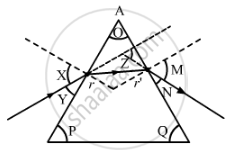
In this diagram, the angle of prism, angle of incidence, angle of emergence and angle of deviation, respectively, have been represented by:
(A) O, Y, Z and N,
(B) P, Y, M and Z,
(C) O, X, M and Z,
(D) P, X, Z and N.
Draw a ray diagram to explain the term angle of deviation.
- A ray of white light breaks up into its components while passing through a glass prism. Draw a ray diagram to show the path of rays.
- Mark the least deviated colour in your diagram.
- Why do different coloured rays deviate differently in a prism?
What is spectrum?
What is a rainbow?
Which of the following colour of white light has the least wavelength?
(a) red
(b) orange
(c) violet
(d) blue
Why do you not see a spectrum of colours when light passes through a flat pane of glass?
The seven colours in the spectrum of sunlight in order, are represented as :
In the spectrum of white light by a prism, the colour at the extreme end opposite to the base of prism is ______.
The frequency range of visible light is from 3.75 × 10¹⁴ Hz to 7.5 × 10¹⁴ Hz. Calculate its wavelength range. Take speed of light = 3 × 10⁸ m/s.
A wave has wavelength 50Å of name the wave.
Which characteristic property of light is responsible for the blue colour of the sky?
Write three conditions necessary to obtain a pure spectrum on a screen. Name the instrument in which the conditions stated by you are fulfilled.
Distinguish between an impure spectrum and a pure spectrum.
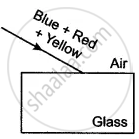
In the figure, a beam of light consisting of three colours blue, red, and yellow is incident on a prism and on a rectangular glass block respectively. Complete the diagram by drawings of the refracted and emergent rays.
State True or False:
"Wavelength of red light is close to 700 nm.”
Observe the given diagram and answer the questions:
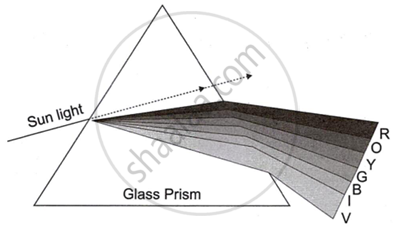
- Name the process shown in the figure.
- Name the colour that deviates the most.
- Name the colour that deviates the least.
- Name any one phenomenon in nature which is based on the above process.
- Define ‘spectrum’.
Make a rainbow
Try to make your own rainbow. You can try this project in the morning or in the evening. Stand with your back towards the Sun. Take a hosepipe or a water pipe used in the garden. Make a fine spray in front of you. You can see different colours of rainbow in the spray.
