Advertisements
Advertisements
Question
The colour of white light which is deviated the maximum on passing through the glass prism is:
(a) blue
(b) indigo
(c) red
(d) orange
Advertisements
Solution
indigo
Among the colours blue, indigo, red and orange, indigo is deviated the maximum on passing through a glass prism.
APPEARS IN
RELATED QUESTIONS
A narrow beam PQ of white light is passing through a glass prism ABC as shown in the diagram.

Trace it on your answer sheet and show the path of the emergent beam as observed on the screen DE.
(i) Write the name and cause of the phenomenon observed.
(ii) Where else in nature is this phenomenon observed?
(iii) Based on this observation, state the conclusion which can be drawn about the constituents of white light.
The path of a ray of light passing through a glass prism is shown below:
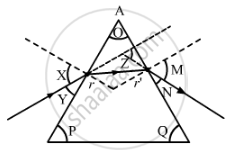
In this diagram, the angle of prism, angle of incidence, angle of emergence and angle of deviation, respectively, have been represented by:
(A) O, Y, Z and N,
(B) P, Y, M and Z,
(C) O, X, M and Z,
(D) P, X, Z and N.
Draw a ray diagram to explain the term angle of deviation.
As light rays emerge from a glass prism into air, are they refracted towards or away from the normal?
When a ray of light enters a prism, it bends ______ the normal; as it leaves the prism, it bends ______ the normal.
Which of the following coloured light has the least speed in glass prism?
(a) violet
(b) yellow
(c) red
(d) green
The coloured light having the maximum speed in glass prism is ______.
The frequency range of visible light is from 3.75 × 10¹⁴ Hz to 7.5 × 10¹⁴ Hz. Calculate its wavelength range. Take speed of light = 3 × 10⁸ m/s.
An object is placed in front of a converging lens and in front of a diverging lens as in fig.
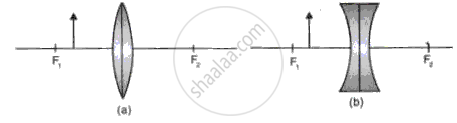
(a)Complete the ray diagram to obtain an image.
(b)Compare the nature of image formed by both the lenses in the above case.
The phenomenon of splitting of light into its component colours is ___________ .
How can the presence of ultraviolet radiation be detected?
State two uses of ultraviolet radiation.
Distinguish between an impure spectrum and a pure spectrum.
Write an Explanation.
Critical angle
When white light enters a glass prism from the air, the angle of deviation is least for ____________.
The phenomena of light involved in the formation of rainbow are ______.
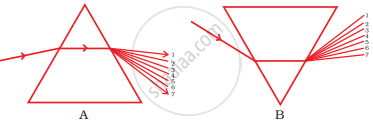
State the correct sequence (1-7) of colours in the spectrum formed by the prisms A and B, shown in the following figure.
What is Newton’s disc?
The angle of deviation through a prism is minimum when

- Incident rays and emergent rays are symmetric to the prism.
- The refracted ray inside the prism becomes parallel to its base.
- The angle of incidence is equal to that of the angle of emergence.
- When the angle of emergence has doubled the angle of incidence.
Choose the correct answer from the options given below:
dispersive power of crown glass? Given that µv = 1.5230, µr = 1.5145
