Advertisements
Advertisements
प्रश्न
The colour of white light which is deviated the maximum on passing through the glass prism is:
(a) blue
(b) indigo
(c) red
(d) orange
Advertisements
उत्तर
indigo
Among the colours blue, indigo, red and orange, indigo is deviated the maximum on passing through a glass prism.
APPEARS IN
संबंधित प्रश्न
What happens when a ray of ordinary light is passed through a triangular glass prism?
What is spectrum?
A ray of light moving from an optically rarer to a denser medium
In an experiment to trace the path of a ray of light through a glass prism for different values of angle of incidence a student would find that the emergent ray:
(A) is parallel to the incident ray
(B) perpendicular to the incident ray
(C) is parallel to the refracted ray
(D) bends at an angle to the direction of incident ray
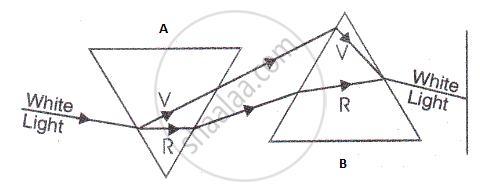
Complete the ray diagram given below to show the nature of light produced on the screen.
The completed ray diagram is as shown below:
A wave has wavelength 50Å of State the speed in vacuum.
The phenomenon of splitting of light into its component colours is ___________ .
How can the presence of ultraviolet radiation be detected?
Distinguish between an impure spectrum and a pure spectrum.
Suggest one way, in each case, by which we can detect the presence of Infrared radiations.
Sunlight entering through a narrow aperture falls on a prism. Draw a neat labelled ray diagram to show the formation of the spectrum on a screen. Name the colour obtained nearer the base of the prism.
Write an Explanation.
Critical angle
Say TRUE or FALSE
Rainbow is formed by dispersion of which light by water drops
What is dispersion? Explain in detail.
The phenomena of light involved in the formation of rainbow are ______.
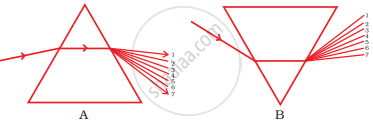
State the correct sequence (1-7) of colours in the spectrum formed by the prisms A and B, shown in the following figure.
In dispersion, the color of light that will bend more is ______.
What is a rainbow?
The dispersive powers of flint glass and crown glass are 0.053 and 0.034, respectively and their mean refractive indices are 1.68 and 1.53 for white light. Calculate the angle of the flint glass prism required to form an achromatic combination with a crown glass prism of refracting angle 4°:
State True or False:
"Wavelength of red light is close to 700 nm.”
