Advertisements
Advertisements
प्रश्न
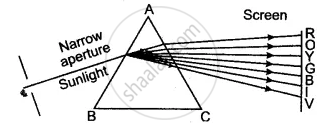
Sunlight entering through a narrow aperture falls on a prism. Draw a neat labelled ray diagram to show the formation of the spectrum on a screen. Name the colour obtained nearer the base of the prism.
Advertisements
उत्तर
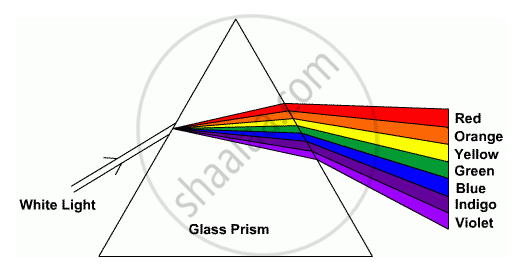
The labelled ray diagram showing the formation of the spectrum of sunlight on a screen is given below. The colour obtained nearer the base of the prism is violet.
संबंधित प्रश्न
Draw a ray diagram to explain the term angle of deviation.
As light rays pass from air into a glass prism, are they refracted towards or away from the normal?
What are the seven colours seen in a rainbow?
State the speed of light in (a) air, (b) water, and (c) glass
Draw a labeled ray diagram to illustrate the dispersion of a narrow beam of white light when it passes through a glass prism.
If a monochromatic beam of light undergoes minimum deviation through an equiangular prism, how does the beam pass through the prism, with respect to its base?
The phenomenon of splitting of light into its component colours is ___________ .
State two uses of ultraviolet radiation.
What do you understand by spectrum? Name the seven prominent colours in order, as obtained in the spectrum of white light.
Which of the following is a natural phenomenon which is caused by the dispersion of sunlight in the sky?
