Advertisements
Advertisements
प्रश्न
State the colour which bends:
- The most.
- The least while passing through a glass prism.
Advertisements
उत्तर
- Violet is the colour that bends the most when white light travels through a glass prism because it has the shortest wavelength and is refracted the most.
- Red, on the other hand, is the colour that bends the least because it has the longest wavelength and experiences the least amount of refractive error. Indigo, blue, green, yellow, and orange are the other colours of the spectrum, which are indicated in order of increasing wavelength.
APPEARS IN
संबंधित प्रश्न
A student is observing a diagram showing the path of a ray of light passing through a glass prism. He would find that for all angles of incidence the ray of light bends:
- A ray of white light breaks up into its components while passing through a glass prism. Draw a ray diagram to show the path of rays.
- Mark the least deviated colour in your diagram.
- Why do different coloured rays deviate differently in a prism?
When a beam of white light is passed through a prism, it splits to form lights of seven colours. Is it possible to recombine the lights of seven colours to obtain the white light again? Explain your answer.
Which of the following colour of white light is least deviated by the prism?
(a) green
(b) violet
(c) indigo
(d) yellow
Draw a labeled ray diagram to illustrate the dispersion of a narrow beam of white light when it passes through a glass prism.
Write three conditions necessary to obtain a pure spectrum on a screen. Name the instrument in which the conditions stated by you are fulfilled.
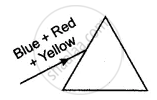
In the figure, a beam of light consisting of three colours blue, red, and yellow is incident on a prism and on a rectangular glass block respectively. Complete the diagram by drawings of the refracted and emergent rays.
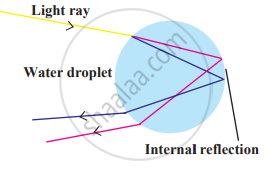
Rainbow is a beautiful natural phenomenon. It is the combined effect of a natural three processes together produced by light. Write it into the circle.
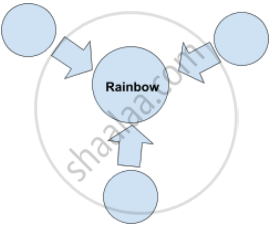
The splitting of white light in to seven colors is called ______.
When white light enters a glass prism from the air, the angle of deviation is least for ____________.
