Advertisements
Advertisements
प्रश्न
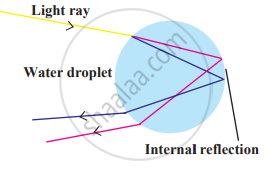
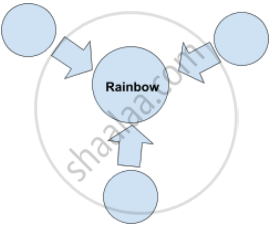
Rainbow is a beautiful natural phenomenon. It is the combined effect of a natural three processes together produced by light. Write it into the circle.
Advertisements
उत्तर
Rainbow-
- Refraction
- Dispersion
- Total internal reflection
APPEARS IN
संबंधित प्रश्न
A student traces the path of a ray of light through a triangular glass prism for different values of angle of incidence. On analyzing the ray diagrams, which one of the following conclusions is he likely to draw?
(A) The emergent ray is parallel to the incident ray.
(B) The emergent ray bends at an angle to the direction of the incident ray.
(C) The emergent ray and the refracted ray are at right angles to each other.
(D) The emergent ray is perpendicular to the incident ray.
In the following ray diagram the correctly marked angle are:

(a) ∠i and ∠e
(b) ∠A and ∠D
(c) ∠i, ∠e and ∠D
(d) ∠r, ∠A and ∠D
A student is observing a diagram showing the path of a ray of light passing through a glass prism. He would find that for all angles of incidence the ray of light bends:
Why do the component colours of incident white light split into a spectrum while passing through a glass prism, explain
Define the term dispersion of white light.
- A ray of white light breaks up into its components while passing through a glass prism. Draw a ray diagram to show the path of rays.
- Mark the least deviated colour in your diagram.
- Why do different coloured rays deviate differently in a prism?
Which is refracted most by a prism : red light or violet light? Explain why?
Which of the following colour of white light has the least wavelength?
(a) red
(b) orange
(c) violet
(d) blue
Out of air and glass, which is optically rarer? Give reason.
What do you understand by the term spectrum? Name the various colours present in the spectrum of sunlight.
Define the term dispersion of light.
Explain the cause of dispersion of white light through a prism.
- A beam of monochromatic light undergoes minimum deviation through an equiangular prism, how does the beam pass through the prism, with respect to its base?
- If white light is used in the same way as in part (a) above, what change do you expect in the emergent beam?
- What conclusion do you draw about the nature of white light in part (b)?
In an experiment to trace the path of a ray of light through a triangular glass prism, a student would observe that the emergent ray
(a) is parallel to the incident ray.
(b) is along the same direction of incident ray.
(c) gets deviated and bends towards the thinner part of the prism.
(d) gets deviated and bends towards the thicker part (base) of the prism.
A student has to trace the path of a ray of light through a glass prism. List four precautions he should observe for better results.
Say TRUE or FALSE
Rainbow is formed by dispersion of which light by water drops
What is Newton’s disc?
In dispersion, the color of light that will bend more is ______.
Assertion: We can see the rainbow in the sky when the rain starts falling after a spell of bright sunlight.
Reason: The rainbow is formed due to the dispersion of light.
In the following diagram showing dispersion of white light by a glass prism, the colours 'P' and 'Q’ respectively are:

