Advertisements
Advertisements
प्रश्न
Explain the cause of dispersion of white light through a prism.
What is the cause of dispersion of white light through a glass prism?
Advertisements
उत्तर
When white light is incident on the first surface of a prism and enters glass, light of different colours due to different speeds in glass, is refracted or deviated through different angles. Thus, the dispersion of white light into its constituent colours takes place at the first surface of the prism. Thus, the cause of dispersion is the change in the speed of light with wavelength or frequency.
संबंधित प्रश्न
When a beam of white light is passed through a prism, it splits to form lights of seven colours. Is it possible to recombine the lights of seven colours to obtain the white light again? Explain your answer.
A ray of light moving from an optically rarer to a denser medium
The diagram below shows the path taken by a narrow beam of yellow monochromatic light passing through an equiangular glass prism. If the yellow light is replaced by a narrow beam of white light incident at the same angle, draw another diagram to show the passage of white light through the prism and label it to show the effect of prism on the white light.

If a monochromatic beam of light undergoes minimum deviation through an equiangular prism, how does the beam pass through the prism, with respect to its base?
Which characteristic property of light is responsible for the blue colour of the sky?
Sunlight entering through a narrow aperture falls on a prism. Draw a neat labelled ray diagram to show the formation of the spectrum on a screen. Name the colour obtained nearer the base of the prism.
Observe the given figure and answer the following questions.
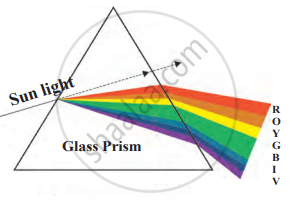
- Which colour light rays bend most?
- Which colour light rays bend least.
- What is the wavelength of violet light rays?
The splitting of white light into its component colours is called ____________.
What is Newton’s disc?
