Advertisements
Advertisements
प्रश्न
State the cause of dispersion of white light
Advertisements
उत्तर
When a beam of white light enters a prism, it gets refracted at the point and splits into its seven constituent colors, viz. violet, indigo, blue, green, yellow, orange, and red. The acronym for the seven constituent colors of white light is VIBGYOR. This splitting of the light rays occurs because of the different angles of bending for each color and this different angles of bending occur because the different component of light faces different refractive indices when passing through the glass prism.
When a narrow beam of sunlight is allowed to fall on one of the rectangular surfaces of the glass prism, we obtain a colored spectrum with red and violet color at its extreme.
APPEARS IN
संबंधित प्रश्न
Why do the component colours of incident white light split into a spectrum while passing through a glass prism, explain
In the figure given alongside, a narrow beam of white light is shown to pass through a triangular glass prism. After passing through the prism, it produces a spectrum YX on the screen.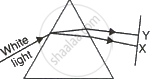
- State the colour seen
- at X, and
- at Y.
- Why do different colours of white light bend through different angles with respect to the incident beam of light?
Draw a diagram to show how white light can be dispersed into a spectrum by using a glass prism. Mark the various colours of the spectrum.
How could you show that the colours of the spectrum combine to give white light?
The colour of white light which suffers the maximum bending (or maximum refraction) on passing through a glass prism is:
(a) yellow
(b) orange
(c) red
(d) violet
State the speed of light in (a) air, (b) water, and (c) glass
A ray of white light falls on a prism. Draw a ray diagram to show that the prism disperses the white light.
In an experiment to trace the path of a ray of light through a glass prism for different values of angle of incidence a student would find that the emergent ray:
(A) is parallel to the incident ray
(B) perpendicular to the incident ray
(C) is parallel to the refracted ray
(D) bends at an angle to the direction of incident ray
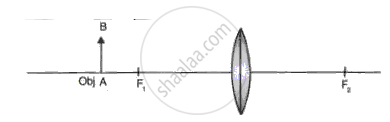
An object AB is placed in front of a convex lens as shown in fig. 4. Complete the ray diagram and obtain the image formed and state the nature of the image.
Suggest one way, in each case, by which we can detect the presence of Infrared radiations.
