Advertisements
Advertisements
प्रश्न
The splitting up of white light into seven colours on passing through a glass prism is called ______.
विकल्प
refraction
deflection
dispersion
scattering
reflection
Advertisements
उत्तर
The splitting up of white light into seven colours on passing through a glass prism is called dispersion.
संबंधित प्रश्न
A narrow beam PQ of white light is passing through a glass prism ABC as shown in the diagram.

Trace it on your answer sheet and show the path of the emergent beam as observed on the screen DE.
(i) Write the name and cause of the phenomenon observed.
(ii) Where else in nature is this phenomenon observed?
(iii) Based on this observation, state the conclusion which can be drawn about the constituents of white light.
In the following ray diagram the correctly marked angle are:

(a) ∠i and ∠e
(b) ∠A and ∠D
(c) ∠i, ∠e and ∠D
(d) ∠r, ∠A and ∠D
State the cause of dispersion of white light
When a ray of light enters a prism, it bends ______ the normal; as it leaves the prism, it bends ______ the normal.
A beam of white light is shone onto a glass prism. The light cannot be:
(a) deviated
(b) dispersed
(c) focused
(d) refracted
Which of the following coloured light has the least speed in glass prism?
(a) violet
(b) yellow
(c) red
(d) green
Out of the following, the colour of light having the maximum wavelength is:
(a) violet
(b) indigo
(c) green
(d) orange
The property of splitting of white light into its seven constituent colours is known as
How does the speed of light determine the optical density of a medium?
Out of air and glass, which is optically rarer? Give reason.
While performing the experiment to trace the path of a ray of light passing through a glass prism, four students marked the incident ray and the emergent ray in their diagrams in the manner shown below. 
(A) I
(B) II
(C) III
(D) IV
A glass prism is able to produce the spectrum when white light passes through it, but a glass slab doesn’t produce any spectrum. Explain why it is so.
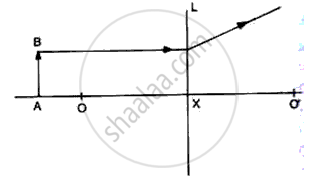
Refer to fig
(i) Name the lens L.
(ii) What are the points O, O' called?
(iii) Complete the diagram to form the image of the object AB.
(iv) Write three characteristics of the image.
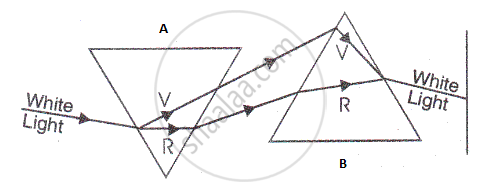
Complete the ray diagram given below to show the nature of light produced on the screen.
The completed ray diagram is as shown below:
A wave has wavelength 50Å of State its one use.
Which characteristic property of light is responsible for the blue colour of the sky?
State two properties of ultraviolet radiation which differ from visible light.
State two uses of ultraviolet radiation.
What do you understand by spectrum? Name the seven prominent colours in order, as obtained in the spectrum of white light.
Distinguish between an impure spectrum and a pure spectrum.
Write the range of wavelength of the infrared spectrum.
Sunlight entering through a narrow aperture falls on a prism. Draw a neat labelled ray diagram to show the formation of the spectrum on a screen. Name the colour obtained nearer the base of the prism.
Observe the given figure and answer the following questions.
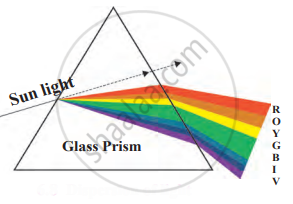
- Which colour light rays bend most?
- Which colour light rays bend least.
- What is the wavelength of violet light rays?
Assertion: We can see the rainbow in the sky when the rain starts falling after a spell of bright sunlight.
Reason: The rainbow is formed due to the dispersion of light.
What is a rainbow?
State True or False:
"Wavelength of red light is close to 700 nm.”
When sunlight passes through water droplets in the atmosphere it gets dispersed into its constituent colours forming a rainbow. A similar phenomenon is observed when white light passes through a prism.
Instead of sunlight, a green-coloured ray is passed through a glass prism. What will be the colour of the emergent ray?
Make a rainbow
Try to make your own rainbow. You can try this project in the morning or in the evening. Stand with your back towards the Sun. Take a hosepipe or a water pipe used in the garden. Make a fine spray in front of you. You can see different colours of rainbow in the spray.
