Advertisements
Advertisements
प्रश्न
A narrow beam PQ of white light is passing through a glass prism ABC as shown in the diagram.

Trace it on your answer sheet and show the path of the emergent beam as observed on the screen DE.
(i) Write the name and cause of the phenomenon observed.
(ii) Where else in nature is this phenomenon observed?
(iii) Based on this observation, state the conclusion which can be drawn about the constituents of white light.
Advertisements
उत्तर

(i) Dispersion of light
Cause: The dispersion of white light occurs because colors of white light travel at different speeds through glass prism. Different colours undergo different deviations on passing through prism.
(ii) Rainbow is the example of dispersion of light observed in nature.
It is caused due to dispersion of sunlight by water droplets in the atmosphere. It always forms in the direction opposite to the sun.
(iii) White light is a mixture of seven colours. The sequence of colours given by the prism is Violet, Indigo, Blue, Green, Yellow, Orange and Red. VIBGYOR is the acronym for this sequence. The red light bends the least and violet light bends the most.
APPEARS IN
संबंधित प्रश्न
In the following diagram the correctly marked angles are :

(a) ∠A and ∠e
(b) ∠i, ∠A and ∠D
(c) ∠A ∠r and ∠e
(b) ∠A ∠r and ∠D
In the formation of spectrum of white light by a prism:
which colour is deviated most?
When a ray of light enters a prism, it bends ______ the normal; as it leaves the prism, it bends ______ the normal.
State the speed of light in (a) air, (b) water, and (c) glass
What do you understand by the term spectrum? Name the various colours present in the spectrum of sunlight.
What do you understand by the term spectrum?
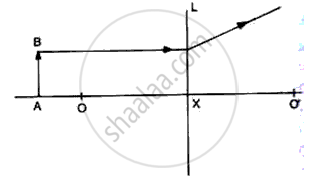
Refer to fig
(i) Name the lens L.
(ii) What are the points O, O' called?
(iii) Complete the diagram to form the image of the object AB.
(iv) Write three characteristics of the image.
Make the correct choice for each of the following:
Which one of the following Fig correctly shows the path of the ray through the glass block?
How can the presence of ultraviolet radiation be detected?
Curved mirrors have surfaces that are spherical, cylindrical, parabolic, and ellipsoid.
