Advertisements
Advertisements
प्रश्न
Explain briefly, with the help of a neat labelled diagram, how white light gets dispersed by a prism. On which surface of a prism, there is both dispersion and deviation of light, and on which surface of the prism, there is only deviation of light ?
Advertisements
उत्तर
When white light is incident on the first surface of a prism and enters in glass, light of different colours due to different speeds in glass, is refracted or deviated through different angles. Thus the dispersion of white light into its constituent colours takes place at the first surface of prism.

On the second surface, only refraction takes place and different colours are deviated through different angles. As a result, the colours get further separated on refraction at the second surface (violet being deviated the most and red the least).
APPEARS IN
संबंधित प्रश्न
A student is observing a diagram showing the path of a ray of light passing through a glass prism. He would find that for all angles of incidence the ray of light bends:
Make two diagrams to explain refraction and dispersion.
A ray of white light falls on a prism. Draw a ray diagram to show that the prism disperses the white light.
In an experiment to trace the path of a ray of light through a triangular glass prism, a student would observe that the emergent ray
(a) is parallel to the incident ray.
(b) is along the same direction of incident ray.
(c) gets deviated and bends towards the thinner part of the prism.
(d) gets deviated and bends towards the thicker part (base) of the prism.
If a monochromatic beam of light undergoes minimum deviation through an equiangular prism, how does the beam pass through the prism, with respect to its base?
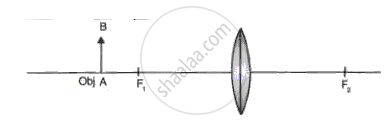
An object AB is placed in front of a convex lens as shown in fig. 4. Complete the ray diagram and obtain the image formed and state the nature of the image.
What is the cause of the dispersion of white light through a glass prism? Draw a ray diagram to show the path of light when two identical glass prisms are arranged together in an inverted position with respect to each other and a narrow beam of white light is allowed to fall obliquely on one of the faces of the prisms.
How can the presence of ultraviolet radiation be detected?
When sunlight passes through water droplets in the atmosphere it gets dispersed into its constituent colours forming a rainbow. A similar phenomenon is observed when white light passes through a prism.
Which colour will show the maximum angle of deviation and which colour will show the minimum angle of deviation?
