Advertisements
Advertisements
प्रश्न
When sunlight passes through water droplets in the atmosphere it gets dispersed into its constituent colours forming a rainbow. A similar phenomenon is observed when white light passes through a prism.
Which colour will show the maximum angle of deviation and which colour will show the minimum angle of deviation?
Advertisements
उत्तर
Violet shows the maximum angle of deviation and red shows the minimum angle of deviation.
APPEARS IN
संबंधित प्रश्न
In the following ray diagram the correctly marked angle are:

(a) ∠i and ∠e
(b) ∠A and ∠D
(c) ∠i, ∠e and ∠D
(d) ∠r, ∠A and ∠D
The path of a ray of light passing through a glass prism is shown below:
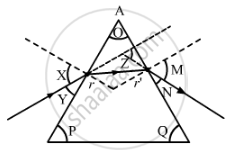
In this diagram, the angle of prism, angle of incidence, angle of emergence and angle of deviation, respectively, have been represented by:
(A) O, Y, Z and N,
(B) P, Y, M and Z,
(C) O, X, M and Z,
(D) P, X, Z and N.
A beam of white light falls on a glass prism. The colour of light which undergoes the least bending on passing through the glass prism is:
(a) violet
(b) red
(c) green
(d) blue
Out of the following, the colour of light having the maximum wavelength is:
(a) violet
(b) indigo
(c) green
(d) orange
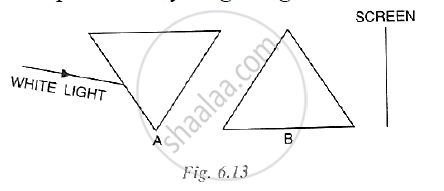
Complete the ray diagram given below to show the nature of light produced on the screen.
Distinguish between an impure spectrum and a pure spectrum.
Observe the given figure and answer the following questions.
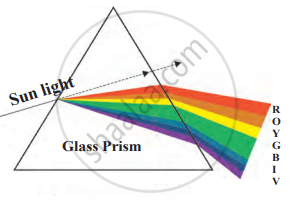
- Which colour light rays bend most?
- Which colour light rays bend least.
- What is the wavelength of violet light rays?
What is dispersion? Explain in detail.
The angle of deviation through a prism is minimum when

- Incident rays and emergent rays are symmetric to the prism.
- The refracted ray inside the prism becomes parallel to its base.
- The angle of incidence is equal to that of the angle of emergence.
- When the angle of emergence has doubled the angle of incidence.
Choose the correct answer from the options given below:
