Advertisements
Advertisements
प्रश्न
In an experiment to trace the path of a ray of light through a triangular glass prism, a student would observe that the emergent ray
(a) is parallel to the incident ray.
(b) is along the same direction of incident ray.
(c) gets deviated and bends towards the thinner part of the prism.
(d) gets deviated and bends towards the thicker part (base) of the prism.
Advertisements
उत्तर
In an experiment to trace the path of a ray of light through a triangular glass prism, a student would observe that the emergent ray gets deviated and bends towards the thicker part (base) of the prism.
Hence, the correct answer is option (d).
APPEARS IN
संबंधित प्रश्न
State the cause of dispersion of white light passing through a glass prism. How did Newton show that white light of sun contains seven colours using two identical glass prisms. Draw a ray diagram to show the path of light when two identical glass prisms are arranged together in inverted position with respect to each other and a narrow beam of white light is allowed to fall obliquely on one of the focus of the first prism.
In the figure given alongside, a narrow beam of white light is shown to pass through a triangular glass prism. After passing through the prism, it produces a spectrum YX on the screen.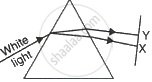
- State the colour seen
- at X, and
- at Y.
- Why do different colours of white light bend through different angles with respect to the incident beam of light?
Which of the following colour of white light has the least wavelength?
(a) red
(b) orange
(c) violet
(d) blue
The property of splitting of white light into its seven constituent colours is known as
The diagram below shows the path taken by a narrow beam of yellow monochromatic light passing through an equiangular glass prism. If the yellow light is replaced by a narrow beam of white light incident at the same angle, draw another diagram to show the passage of white light through the prism and label it to show the effect of prism on the white light.

A ray of white light is passed through a glass prism and a spectrum is obtained on a screen.
- Name the seven colours of the spectrum in order.
- Do the colours have the same width in the spectrum?
- Which of the colour of the spectrum of white light deviates (i) the most, (ii) the least?
Which characteristic property of light is responsible for the blue colour of the sky?
What do you understand by spectrum? Name the seven prominent colours in order, as obtained in the spectrum of white light.
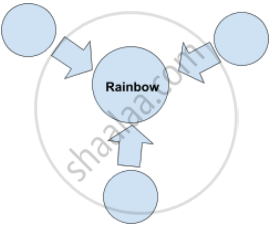
Rainbow is a beautiful natural phenomenon. It is the combined effect of a natural three processes together produced by light. Write it into the circle.
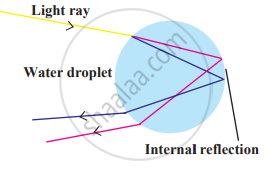
Observe the given figure and write appropriate phenomenon of light in the box.