Advertisements
Advertisements
प्रश्न
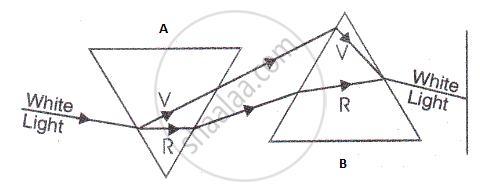
State the cause of dispersion of white light passing through a glass prism. How did Newton show that white light of sun contains seven colours using two identical glass prisms. Draw a ray diagram to show the path of light when two identical glass prisms are arranged together in inverted position with respect to each other and a narrow beam of white light is allowed to fall obliquely on one of the focus of the first prism.
Advertisements
उत्तर
Different colours of light bend through different angles with respect to the incident ray as they pass through a prism. The red light bends the least, while the violet bends the most. Thus, the rays of each colour emerge along different paths and thus become distinct. This is the cause of dispersion of white light passing through a glass prism.
Isaac Newton used two glass prims, with one prism in inverted position to show that white light of the Sun contains seven colours. The set-up has been shown below:-

When white light of the Sun passes through the first prism, it gets dispersed into seven colours. When all the seven colours of the spectrum were passed through the second prism, Newton found a beam of white light emerging from the other side of the second prism. This observation gave Newton the idea that the sunlight is made up of seven colours.
संबंधित प्रश्न
A student is observing a diagram showing the path of a ray of light passing through a glass prism. He would find that for all angles of incidence the ray of light bends:
State the speed of light in (a) air, (b) water, and (c) glass
In which of the following four diagrams is the correct path of a ray of light passing through a glass prism shown ?
Complete the ray diagram given below to show the nature of light produced on the screen.
The completed ray diagram is as shown below:
Suggest one way, in each case, by which we can detect the presence of Infrared radiations.
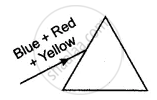
In the figure, a beam of light consisting of three colours blue, red, and yellow is incident on a prism and on a rectangular glass block respectively. Complete the diagram by drawings of the refracted and emergent rays.
Why do we see a rainbow in the sky only after rainfall?
Curved mirrors have surfaces that are spherical, cylindrical, parabolic, and ellipsoid.
During dispersion of white light by prism placed in air, for a particular value of angle of prism,
