Advertisements
Advertisements
Questions
Explain the cause of dispersion of white light through a prism.
What is the cause of dispersion of white light through a glass prism?
Advertisements
Solution
When white light is incident on the first surface of a prism and enters glass, light of different colours due to different speeds in glass, is refracted or deviated through different angles. Thus, the dispersion of white light into its constituent colours takes place at the first surface of the prism. Thus, the cause of dispersion is the change in the speed of light with wavelength or frequency.
RELATED QUESTIONS
- A ray of white light breaks up into its components while passing through a glass prism. Draw a ray diagram to show the path of rays.
- Mark the least deviated colour in your diagram.
- Why do different coloured rays deviate differently in a prism?
What acts as tiny prisms in the formation of a rainbow?
The colour of white light which suffers the maximum bending (or maximum refraction) on passing through a glass prism is:
(a) yellow
(b) orange
(c) red
(d) violet
Why do you not see a spectrum of colours when light passes through a flat pane of glass?
If white light is used in same way what change is expected in the emergent beam?
Write the range of wavelength of the infrared spectrum.
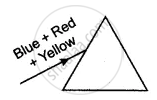
In the figure, a beam of light consisting of three colours blue, red, and yellow is incident on a prism and on a rectangular glass block respectively. Complete the diagram by drawings of the refracted and emergent rays.
Observe the given figure and answer the following questions.
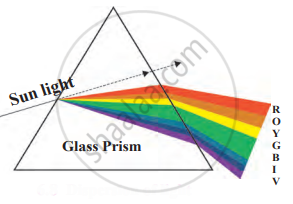
- Which colour light rays bend most?
- Which colour light rays bend least.
- What is the wavelength of violet light rays?
When white light enters a glass prism from the air, the angle of deviation is least for ____________.
The splitting of white light into its component colours is called ____________.
