Advertisements
Advertisements
प्रश्न
Which is refracted most by a prism : red light or violet light? Explain why?
Advertisements
उत्तर
Violet light is refracted the most by a prism. When white light passes through a glass prism, violet colour has the minimum speed and a short wavelength. As violet has a short wavelength, it undergoes the maximum deviation and hence appears at the bottom of the spectrum. On the other hand, red light, which is also a part of the spectrum, has the maximum speed and a longer wavelength, and hence it is the least deviated and forms the upper part of the spectrum.
APPEARS IN
संबंधित प्रश्न
In the following ray diagram the correctly marked angle are:

(a) ∠i and ∠e
(b) ∠A and ∠D
(c) ∠i, ∠e and ∠D
(d) ∠r, ∠A and ∠D
The path of a ray of light passing through a glass prism is shown below:
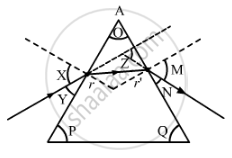
In this diagram, the angle of prism, angle of incidence, angle of emergence and angle of deviation, respectively, have been represented by:
(A) O, Y, Z and N,
(B) P, Y, M and Z,
(C) O, X, M and Z,
(D) P, X, Z and N.
State the cause of dispersion of white light
In the figure given alongside, a narrow beam of white light is shown to pass through a triangular glass prism. After passing through the prism, it produces a spectrum YX on the screen.
Why do different colours of white light bend through different angles with respect to the incident beam of light?
Describe how you could demonstrate that white light is composed of a number of colours.
The colour of white light which is deviated the maximum on passing through the glass prism is:
(a) blue
(b) indigo
(c) red
(d) orange
Out of the following, the colour of light having the maximum wavelength is:
(a) violet
(b) indigo
(c) green
(d) orange
The property of splitting of white light into its seven constituent colours is known as
State the speed of light in (a) air, (b) water, and (c) glass
Explain briefly, with the help of a neat labelled diagram, how white light gets dispersed by a prism. On which surface of a prism, there is both dispersion and deviation of light, and on which surface of the prism, there is only deviation of light ?
The diagram below shows the path taken by a narrow beam of yellow monochromatic light passing through an equiangular glass prism. If the yellow light is replaced by a narrow beam of white light incident at the same angle, draw another diagram to show the passage of white light through the prism and label it to show the effect of prism on the white light.

In an experiment to trace the path of a ray of light through a glass prism for different values of angle of incidence a student would find that the emergent ray:
(A) is parallel to the incident ray
(B) perpendicular to the incident ray
(C) is parallel to the refracted ray
(D) bends at an angle to the direction of incident ray
The wavelength range of white light is ______.
The phenomenon of splitting of light into its component colours is ___________ .
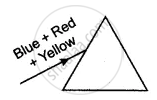
In the figure, a beam of light consisting of three colours blue, red, and yellow is incident on a prism and on a rectangular glass block respectively. Complete the diagram by drawings of the refracted and emergent rays.
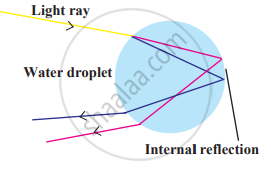
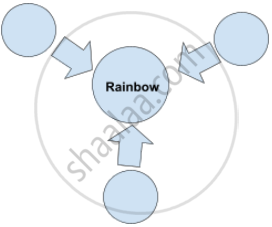
Rainbow is a beautiful natural phenomenon. It is the combined effect of a natural three processes together produced by light. Write it into the circle.
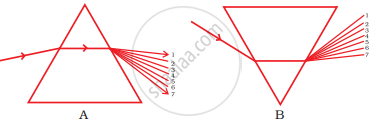
State the correct sequence (1-7) of colours in the spectrum formed by the prisms A and B, shown in the following figure.
Curved mirrors have surfaces that are spherical, cylindrical, parabolic, and ellipsoid.
State the colour which bends:
- The most.
- The least while passing through a glass prism.
