Advertisements
Advertisements
प्रश्न
In the figure given alongside, a narrow beam of white light is shown to pass through a triangular glass prism. After passing through the prism, it produces a spectrum YX on the screen.
Why do different colours of white light bend through different angles with respect to the incident beam of light?
Advertisements
उत्तर
Different colours of white light bend at different angles with respect to the incident beam of light. This is because different colours have different wavelength.
संबंधित प्रश्न
Study the following ray diagram:
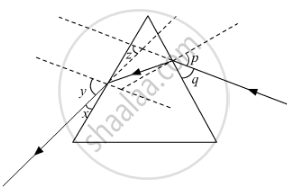
In this diagram, the angle of incidence, the angle of emergence and the angle of deviation respectively have been represented by
(A) y, p, z
(B) x, q, z
(C) p, y, z
(D) p, z, y
- A ray of white light breaks up into its components while passing through a glass prism. Draw a ray diagram to show the path of rays.
- Mark the least deviated colour in your diagram.
- Why do different coloured rays deviate differently in a prism?
Draw a diagram to show how white light can be dispersed into a spectrum by using a glass prism. Mark the various colours of the spectrum.
Which is refracted most by a prism : red light or violet light? Explain why?
The coloured light having the maximum speed in glass prism is ______.
You are given a disc divided into seven sectors with colours violet, indigo, blue, green, yellow, orange and red in them. What would be its colour when it is rotated rapidly?
The diagram below shows the path taken by a narrow beam of yellow monochromatic light passing through an equiangular glass prism. If the yellow light is replaced by a narrow beam of white light incident at the same angle, draw another diagram to show the passage of white light through the prism and label it to show the effect of prism on the white light.

In an experiment to trace the path of a ray of light through a triangular glass prism, a student would observe that the emergent ray
(a) is parallel to the incident ray.
(b) is along the same direction of incident ray.
(c) gets deviated and bends towards the thinner part of the prism.
(d) gets deviated and bends towards the thicker part (base) of the prism.
A glass prism is able to produce the spectrum when white light passes through it, but a glass slab doesn’t produce any spectrum. Explain why it is so.
An object is placed in front of a converging lens and in front of a diverging lens as in fig.
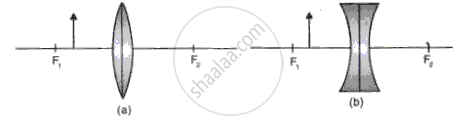
(a)Complete the ray diagram to obtain an image.
(b)Compare the nature of image formed by both the lenses in the above case.
Make the correct choice for each of the following:
Which one of the following Fig correctly shows the path of the ray through the glass block?
A wave has wavelength 50Å of State the speed in vacuum.
A student has to trace the path of a ray of light through a glass prism. List four precautions he should observe for better results.
State two properties of ultraviolet radiation which differ from visible light.
Write the range of wavelength of the visible spectrum.
In the diagram, a narrow beam of white light is incident on a right-angled isosceles prism. The critical angle of the material of prism for the yellow colour of white light is 45°. Complete the diagram to show the path of blue, yellow, and red colours of white light till they emerge out of the prism.
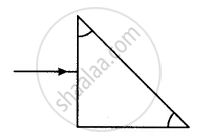
Observe the given figure and answer the following questions.
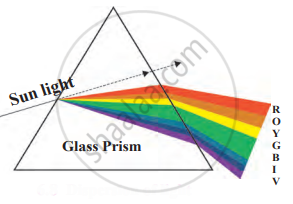
- Which colour light rays bend most?
- Which colour light rays bend least.
- What is the wavelength of violet light rays?
The sunlight can be split into its constituent colors using ______.
When white light enters a glass prism from the air, the angle of deviation is least for ____________.
Curved mirrors have surfaces that are spherical, cylindrical, parabolic, and ellipsoid.
