Advertisements
Advertisements
प्रश्न
You are given a disc divided into seven sectors with colours violet, indigo, blue, green, yellow, orange and red in them. What would be its colour when it is rotated rapidly?
Advertisements
उत्तर

Newton’s colour disc— It is a circular disc taken by Newton to demonstrate that the recombination of seven colours produces white light. A circular cardboard disc which is divided into seven sectors and they were painted with the seven colours of VIBGYOR. The disc when rotated at a very high speed appears WHITE.
APPEARS IN
संबंधित प्रश्न
In the figure given alongside, a narrow beam of white light is shown to pass through a triangular glass prism. After passing through the prism, it produces a spectrum YX on the screen.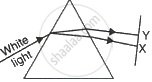
- State the colour seen
- at X, and
- at Y.
- Why do different colours of white light bend through different angles with respect to the incident beam of light?
Describe how you could demonstrate that white light is composed of a number of colours.
Why do you not see a spectrum of colours when light passes through a flat pane of glass?
Write the range of wavelength of the visible spectrum.
Match the Columns:
| Column ‘A’ | Column ‘B’ |
| The wavelength of red light | (a) 600 nm |
| (b) 700 nm | |
| (c) 500 nm |
Name the scientist who was the first to use a glass prism to obtain the spectrum of sunlight.
The splitting of white light into its component colours is called ____________.
______ colour is deviated the least in the spectrum of white light obtained with a glass prism.
A prism of refractive index `sqrt2` and refracting angle A produces minimum deviation δm of a ray on one face at an angle of incidence 45°, The values of A and δm are, respectively ______.
Make a rainbow
Try to make your own rainbow. You can try this project in the morning or in the evening. Stand with your back towards the Sun. Take a hosepipe or a water pipe used in the garden. Make a fine spray in front of you. You can see different colours of rainbow in the spray.
