Advertisements
Advertisements
प्रश्न
An object is placed in front of a converging lens and in front of a diverging lens as in fig.
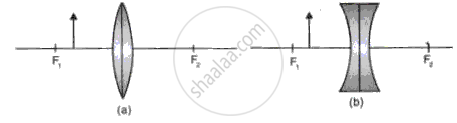
(a)Complete the ray diagram to obtain an image.
(b)Compare the nature of image formed by both the lenses in the above case.
Advertisements
उत्तर
(a)

(b) In both the cases the image formed is virtual, upright and on the same side of the lens but the image formed by a convex lens is magnified and that formed by a concave lens is diminished.
APPEARS IN
संबंधित प्रश्न
When a ray of light enters a prism, it bends ______ the normal; as it leaves the prism, it bends ______ the normal.
How could you show that the colours of the spectrum combine to give white light?
Name the process which is involved in the formation of a rainbow.
What are the seven colours seen in a rainbow?
A beam of white light falls on a glass prism. The colour of light which undergoes the least bending on passing through the glass prism is:
(a) violet
(b) red
(c) green
(d) blue
When we place a glass prism in the path of a narrow beam of white light a spectrum is obtained. What happens when a second identical prism is placed in an inverted position with respect to the first prism? Draw a labelled ray diagram to illustrate it.
The wavelength range of white light is ______.
Why do we see a rainbow in the sky only after rainfall?
Assertion: We can see the rainbow in the sky when the rain starts falling after a spell of bright sunlight.
Reason: The rainbow is formed due to the dispersion of light.
A prism of refractive index `sqrt2` and refracting angle A produces minimum deviation δm of a ray on one face at an angle of incidence 45°, The values of A and δm are, respectively ______.
