Advertisements
Advertisements
प्रश्न
An object is placed in front of a converging lens and in front of a diverging lens as in fig.
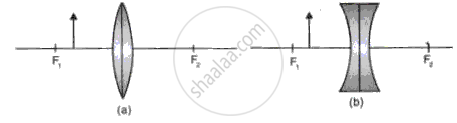
(a)Complete the ray diagram to obtain an image.
(b)Compare the nature of image formed by both the lenses in the above case.
Advertisements
उत्तर
(a)

(b) In both the cases the image formed is virtual, upright and on the same side of the lens but the image formed by a convex lens is magnified and that formed by a concave lens is diminished.
APPEARS IN
संबंधित प्रश्न
A student is observing a diagram showing the path of a ray of light passing through a glass prism. He would find that for all angles of incidence the ray of light bends:
- A ray of white light breaks up into its components while passing through a glass prism. Draw a ray diagram to show the path of rays.
- Mark the least deviated colour in your diagram.
- Why do different coloured rays deviate differently in a prism?
A beam of white light falls on a glass prism. The colour of light which undergoes the least bending on passing through the glass prism is:
(a) violet
(b) red
(c) green
(d) blue
The property of splitting of white light into its seven constituent colours is known as
While performing the experiment to trace the path of a ray of light passing through a glass prism, four students marked the incident ray and the emergent ray in their diagrams in the manner shown below. 
(A) I
(B) II
(C) III
(D) IV
If a monochromatic beam of light undergoes minimum deviation through an equiangular prism, how does the beam pass through the prism, with respect to its base?
The wavelength range of white light is ______.
Answer the following:
What do you mean by dispersion? Name the different colours of light in the proper sequence in the spectrum of light.
The sunlight can be split into its constituent colors using ______.
Why do we see a rainbow in the sky only after rainfall?
